Showing posts with label Orissa. Show all posts

04 October, 2006

Raja-Rani Mandir -- Bhubaneswar

The tour of Bhubaneswar city was to begin at 9:00AM from Pantha Nivas. It was 6:30AM and we had sufficient time to visit Raja Rani temple before the tour commenced. We enquired the directions to Raja Rani temple at the reception and learnt that it was situated about a km away from Panth Nivas. As we walked down the Lewis road towards Raja-Rani mandir, we also looked out for an ICICI cash point to withdraw money. My friend had run out of money and I had sufficient money to sustain myself for the next two days. The previous day the computer at the cash point had a problem (or probably there was a problem with the network???) and 'U' wasn't able to withdraw money. As we approached the cash point we saw a lone customer returning without withdrawing money. It appeared that the problem had not been resolved yet.

We walked further down the road and asked a few locals for the directions to the temple. We were misguided once by a vendor of tender coconuts. A teenager who probably was a college student was walking in the same direction and she offered to walk with us to the temple. We thanked her and walked into the temple garden. We had to buy an entry ticket to see the mandir. Though there was a ticket counter, there wasn't anybody to issue us the entry tickets.


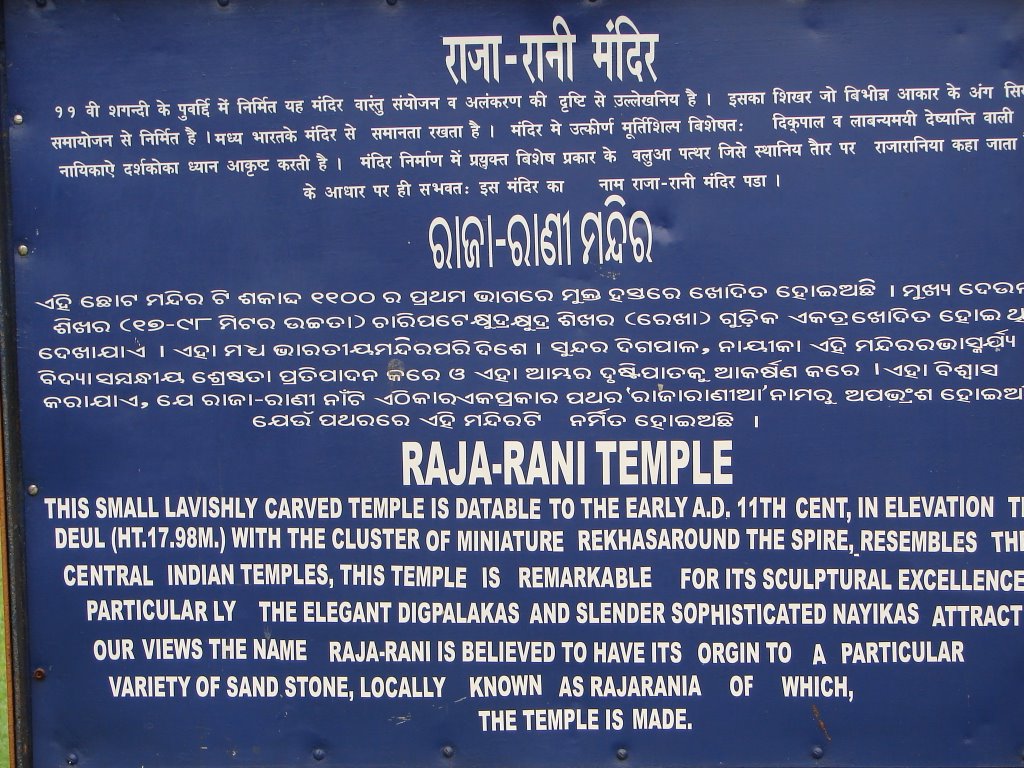
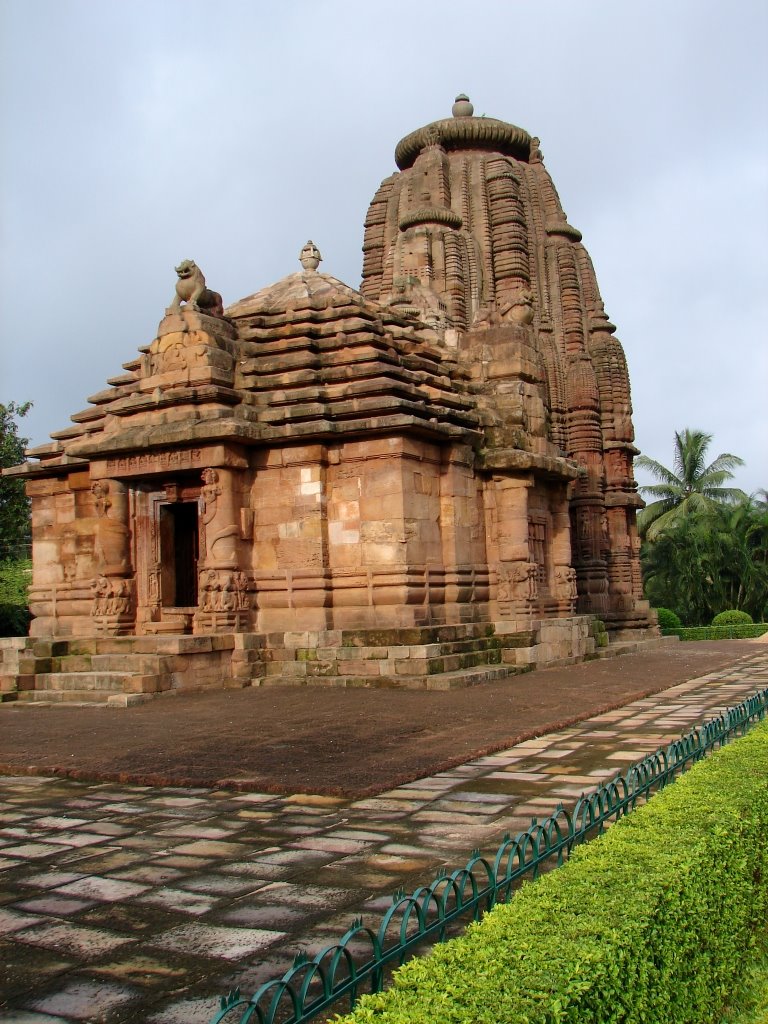
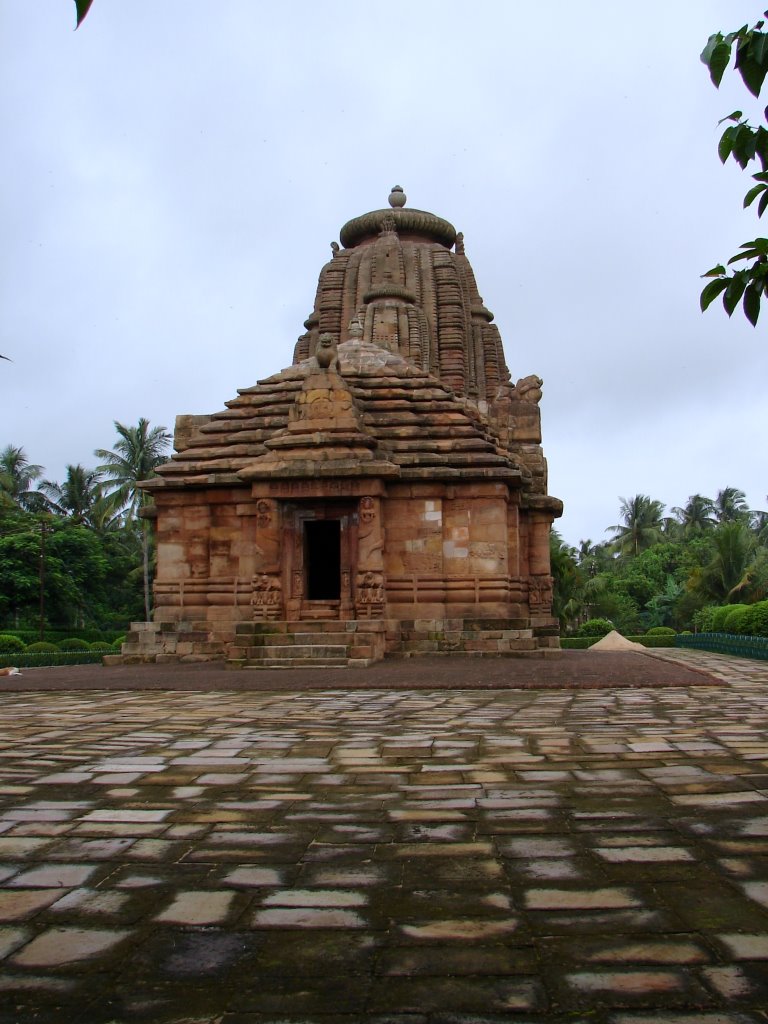
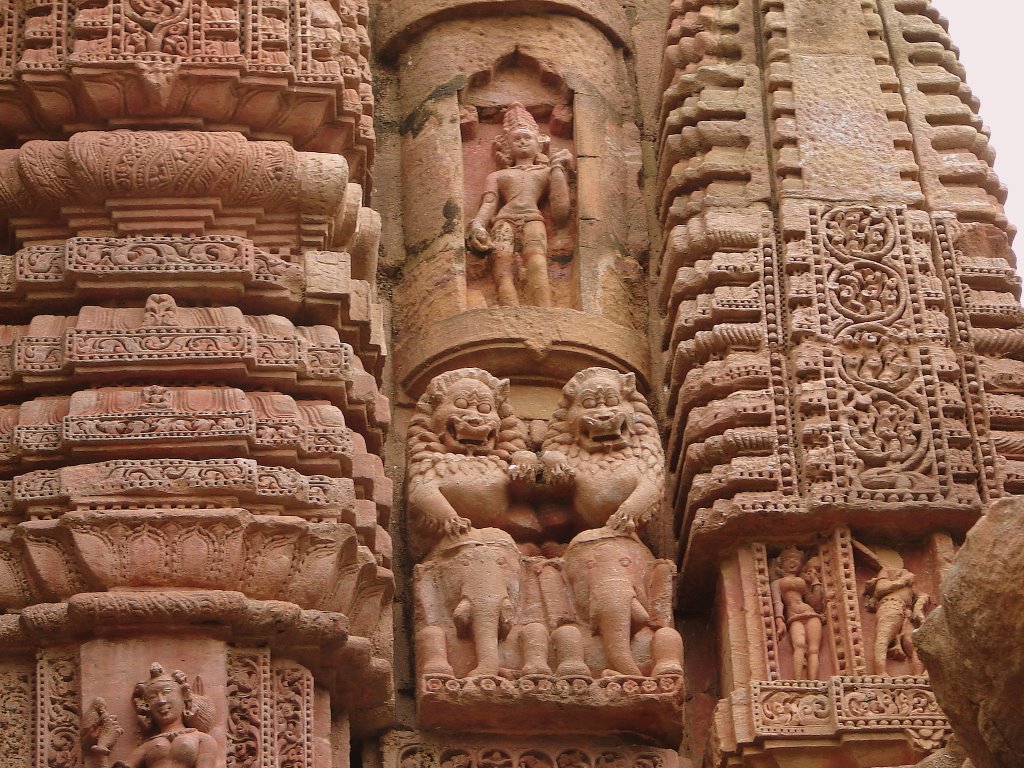
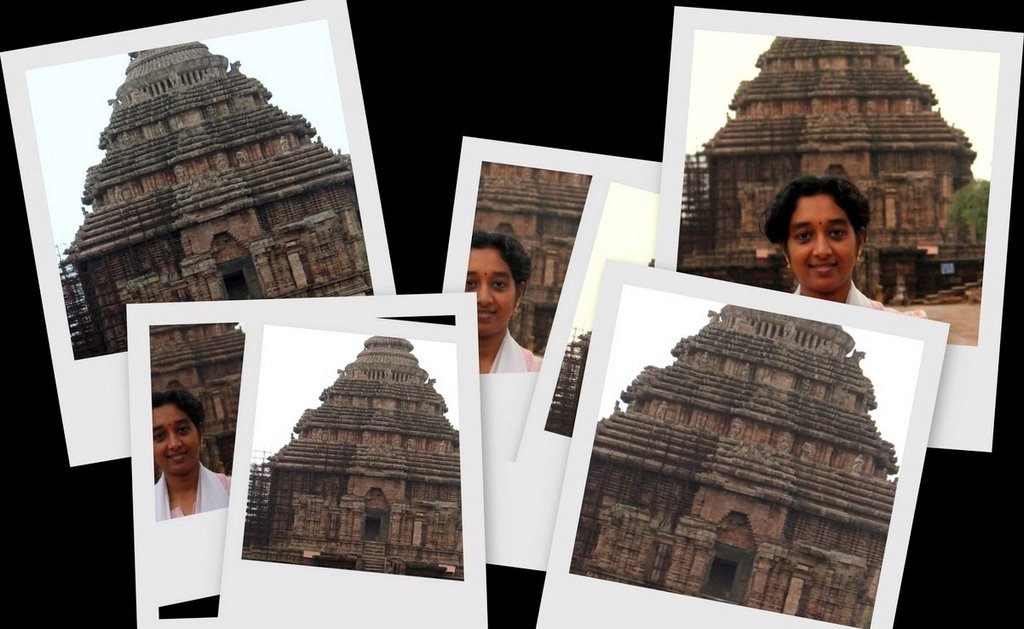
The temple looked stunningly beautiful from far. The Kesari rulers are to be credited for creating this architectural wonder. The Kesaris ruled Kalinga for about 200 years from 9 AD till the advent of the Gangas in 1112AD. The Kesaris were massive builders. Some of the brilliant specimens of Orissan Temples like Lingaraj, Mukteshwar, Rajarani and Brahmeswar were credited to them.


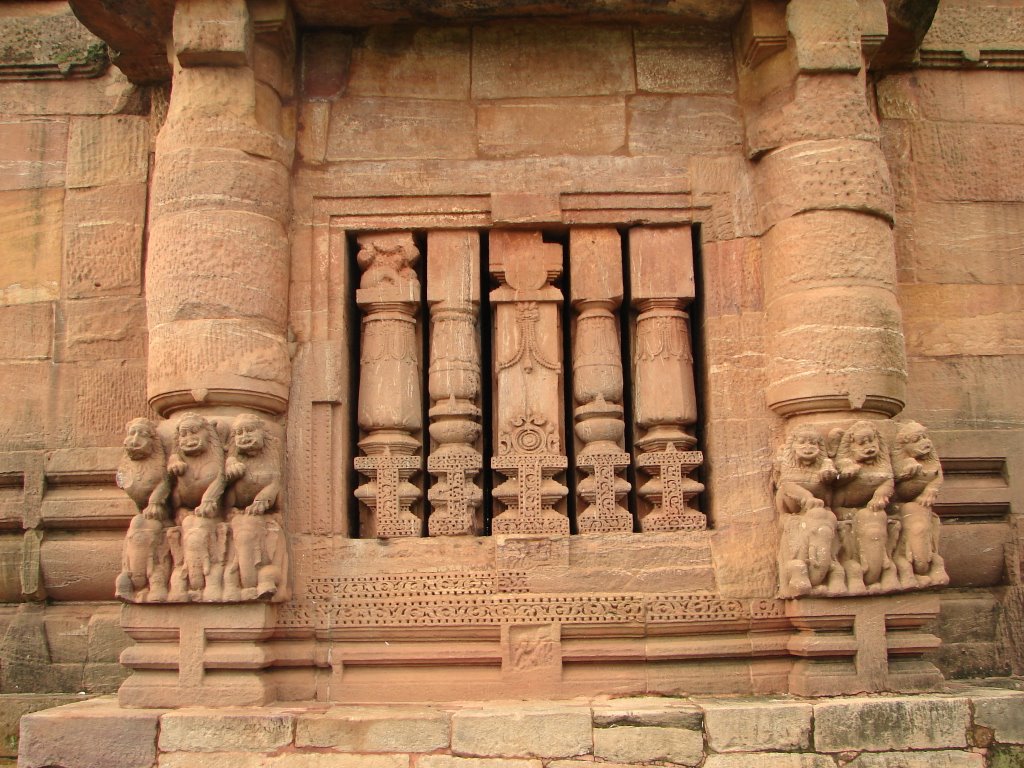
The speciality of this temple is that it has no presiding deity. This temple has been mentioned in few ancient Sanskrit texts. Some scholars believe that the temple was dedicated to worship of Lord Shiva and was known as Indreswara temple. There is also a popular belief that it was the Siddheshwara temple in bygone days. Though I have never been to Khajuraho, I have heard that the temple has family resemblance with Kandariya Mahadeva temple of Khajuraho. The name 'RajaRani' sounds rather too uncommon considering the fact that all the major temples in and around Bhubaneswar have suffixes that link them directly with Lord Shiva.


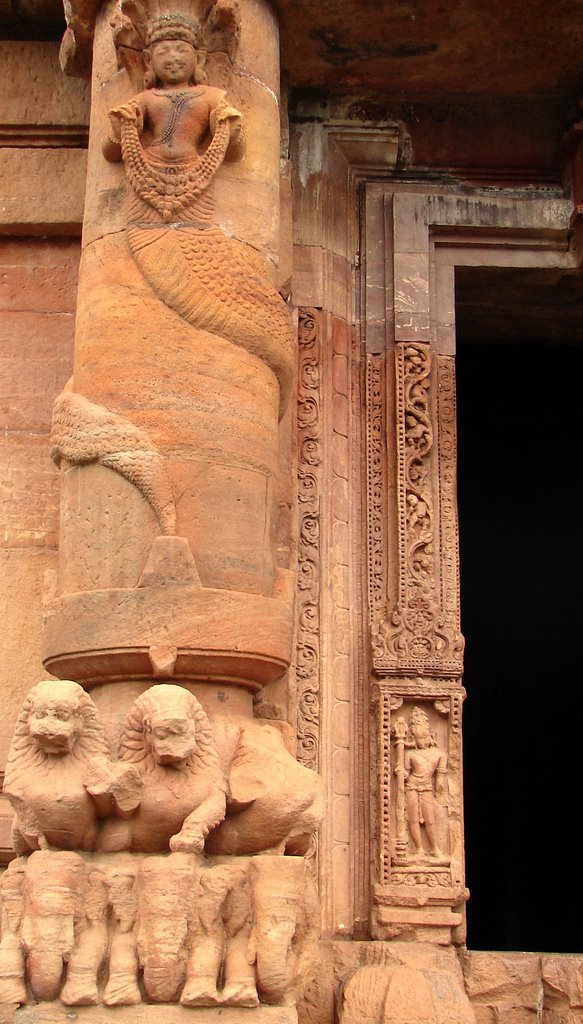
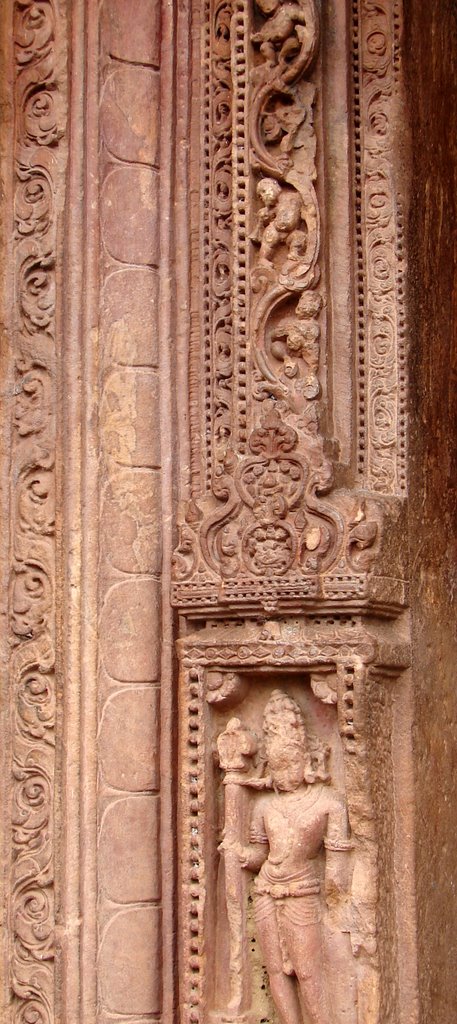
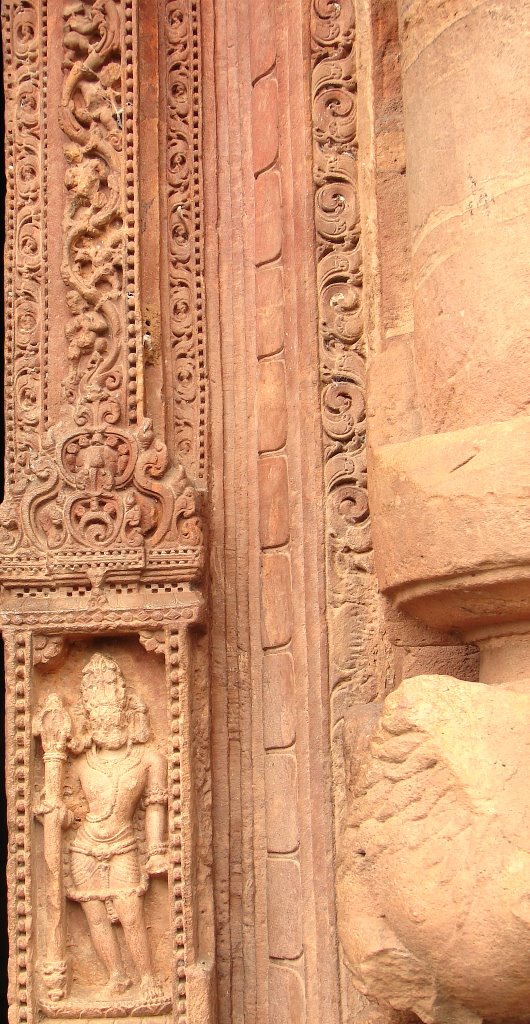
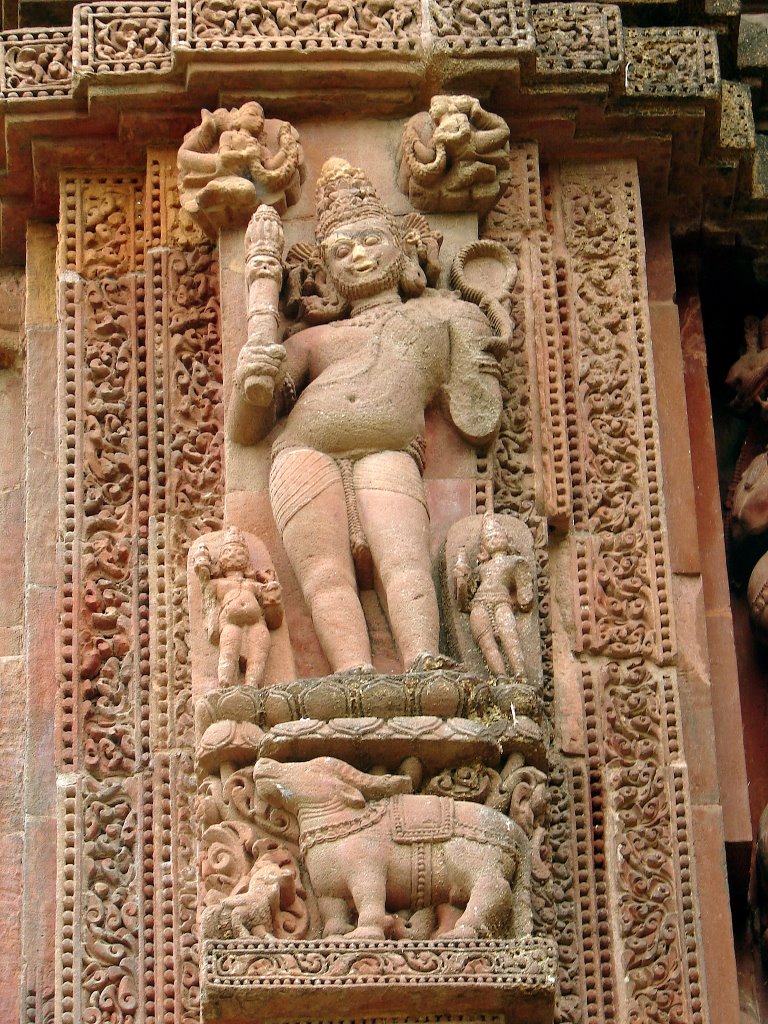
The entrance is guarded by a pair of identical door keepers. They have matted locks on head and carry tridents in hand which make it easy to identifyf them as Shaivite dwarapalakas -- Chanda and Prachanda.


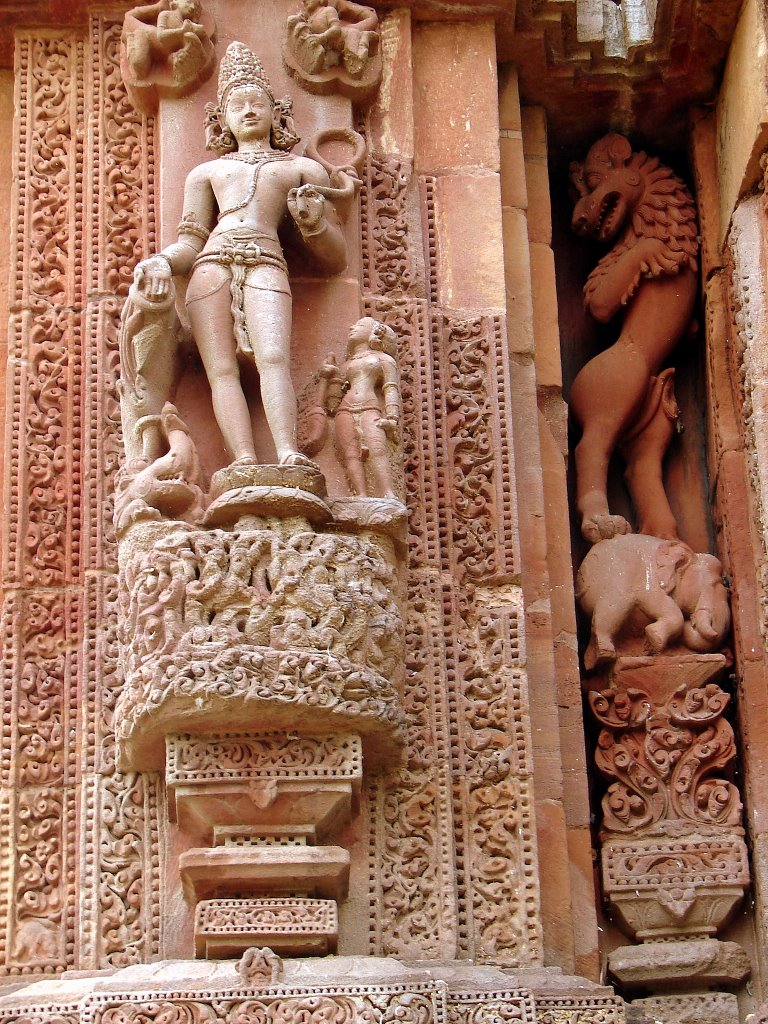
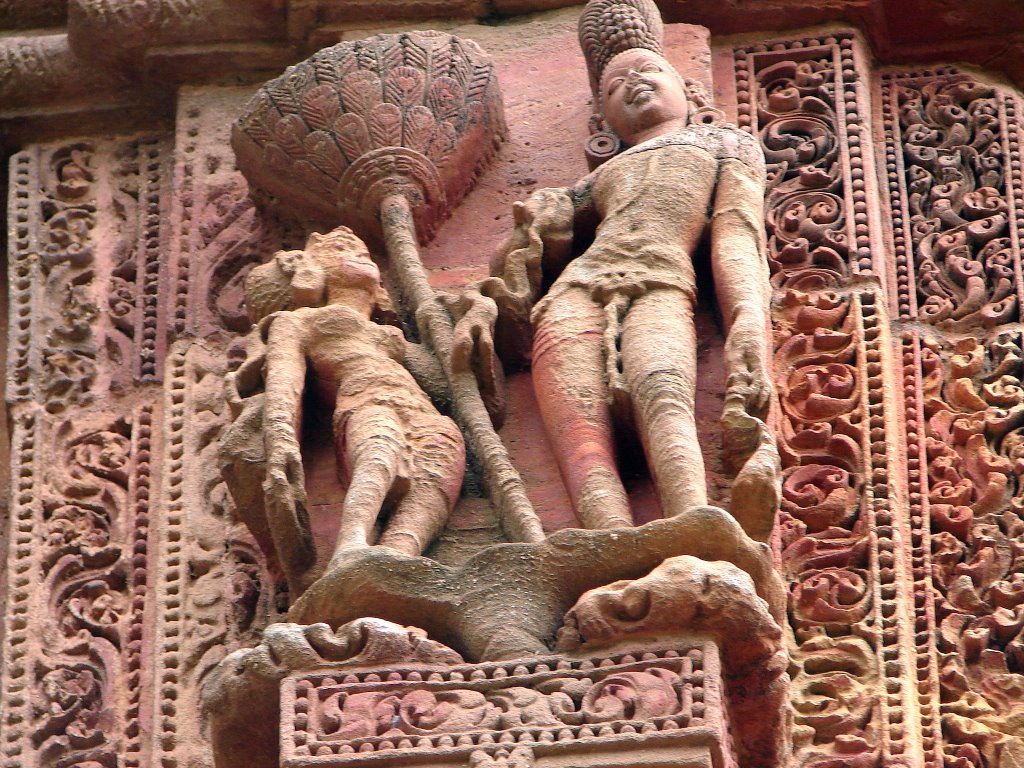
There are ashta dikpalakas(guardians of the eight directions). Indra holds his thunderbolt and guards the east.


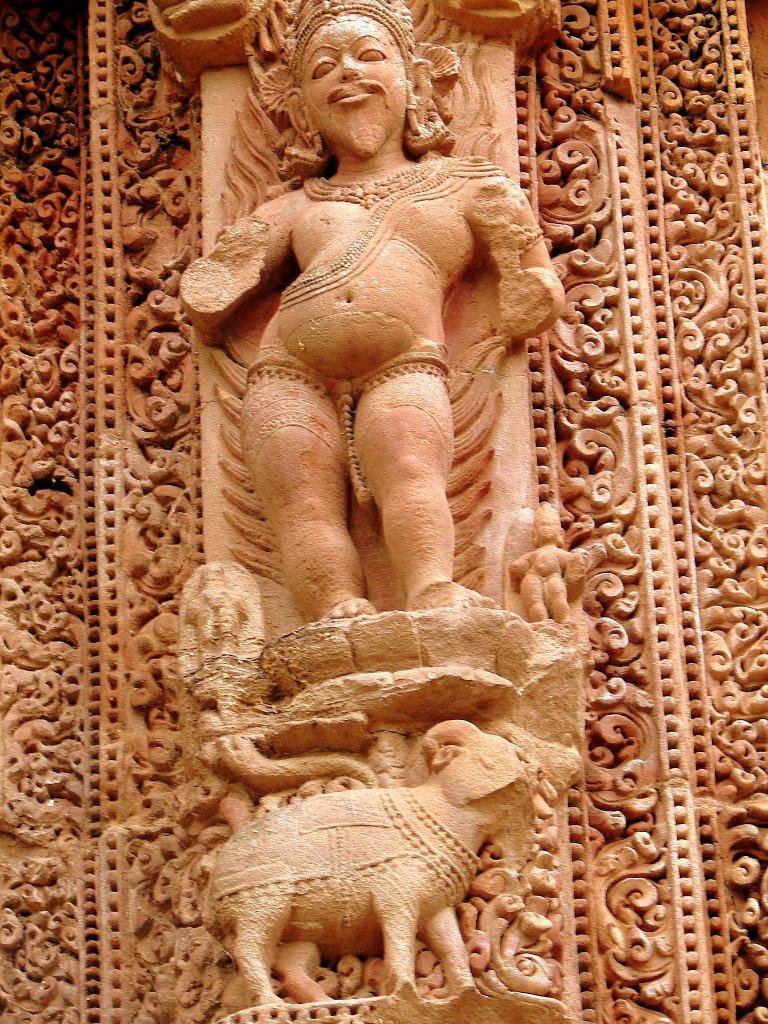
The pot bellied and bearded Agni controls the south-east.


Yama with his staff and noose in hand and his carrier bufallo protects the south.


Nritti is poised over a prostrate body and holding a sword and a severed head guards the south-west. I do not have the picture :( as I wasn't able to locate it :(


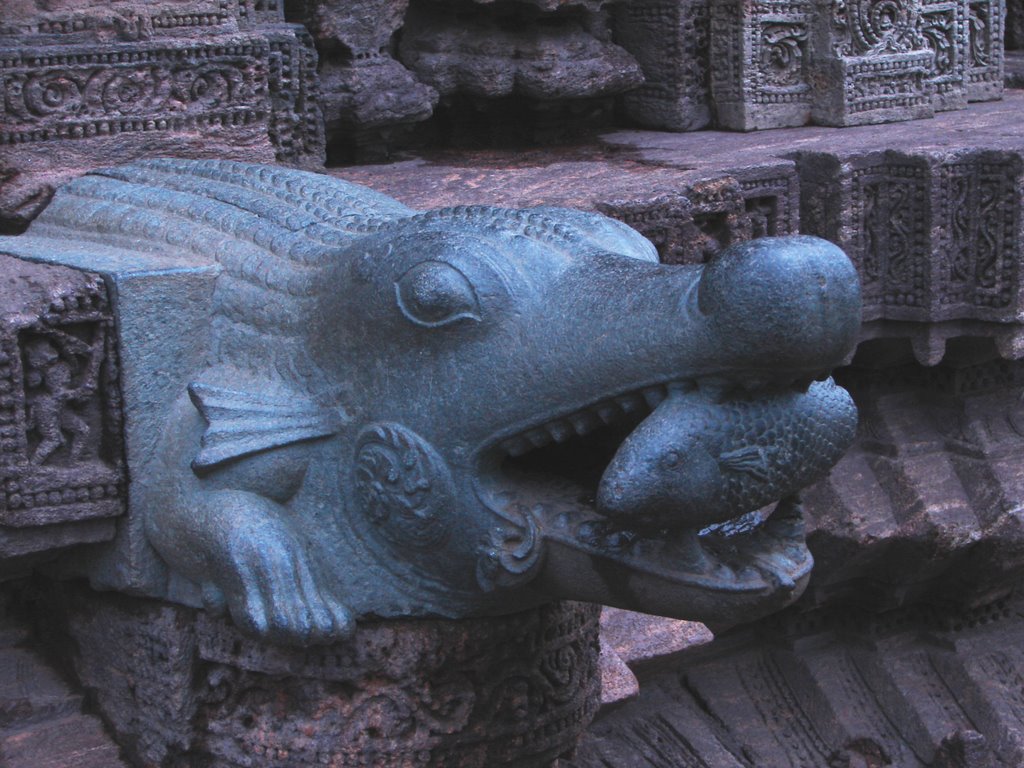
Varuna with a noose in his left hand and his right hand in Vara mudra and his mount makara (crocodile) besides him, preserves the west.


Vayu holds a banner and is placed in the north-west. Kubera with seven jars of nidhi keeps vigil in the north and Ishana with an emaciated figure by his side protects the north-east. Unfortunately, I don't have the pictures :(.

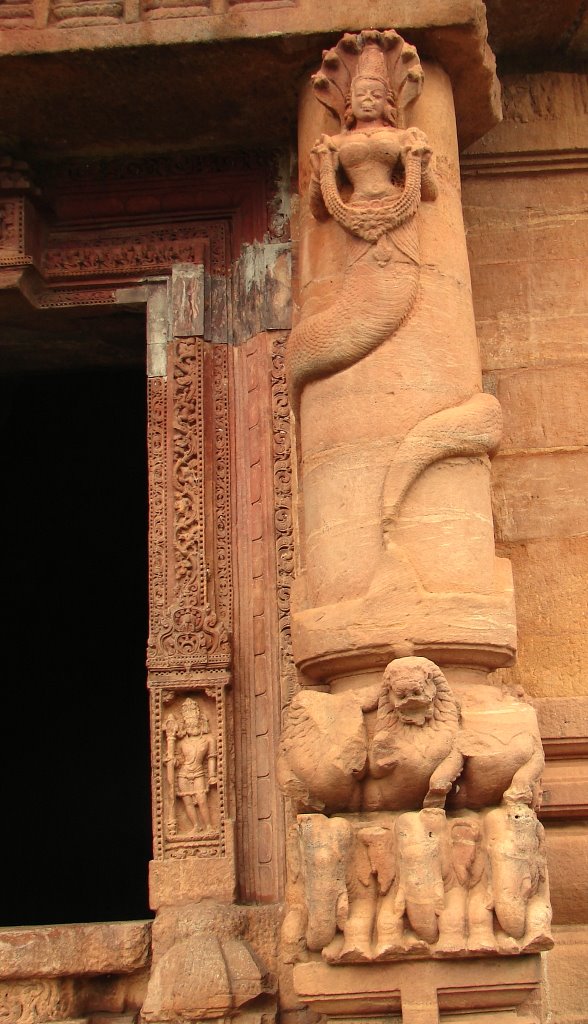
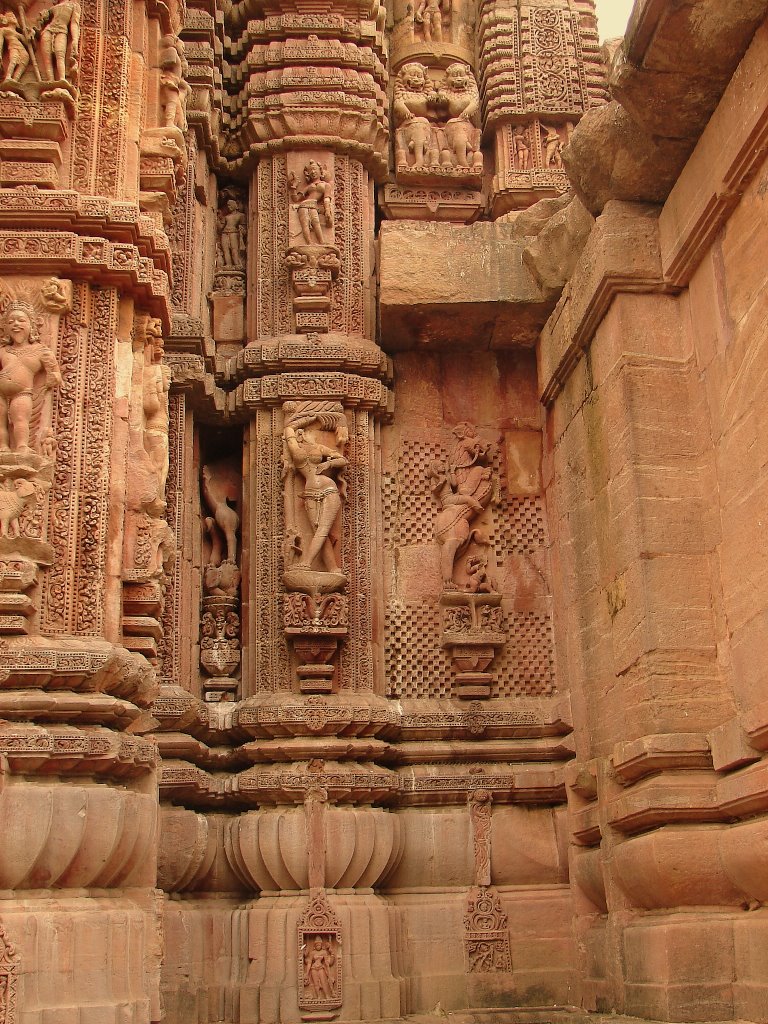
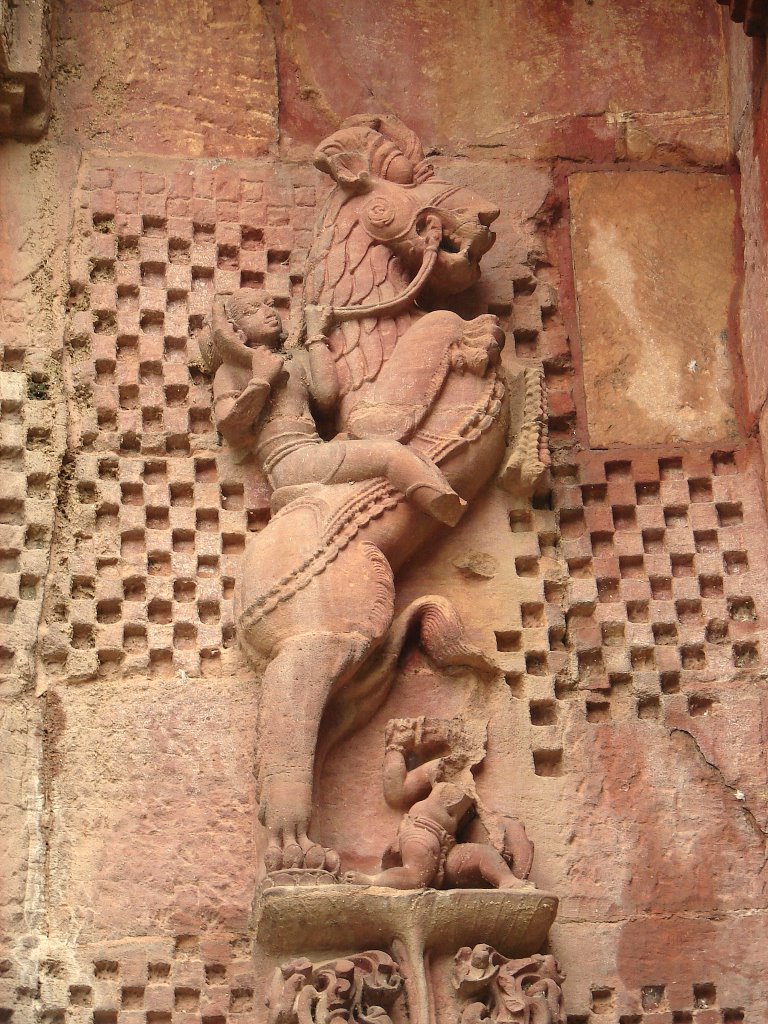
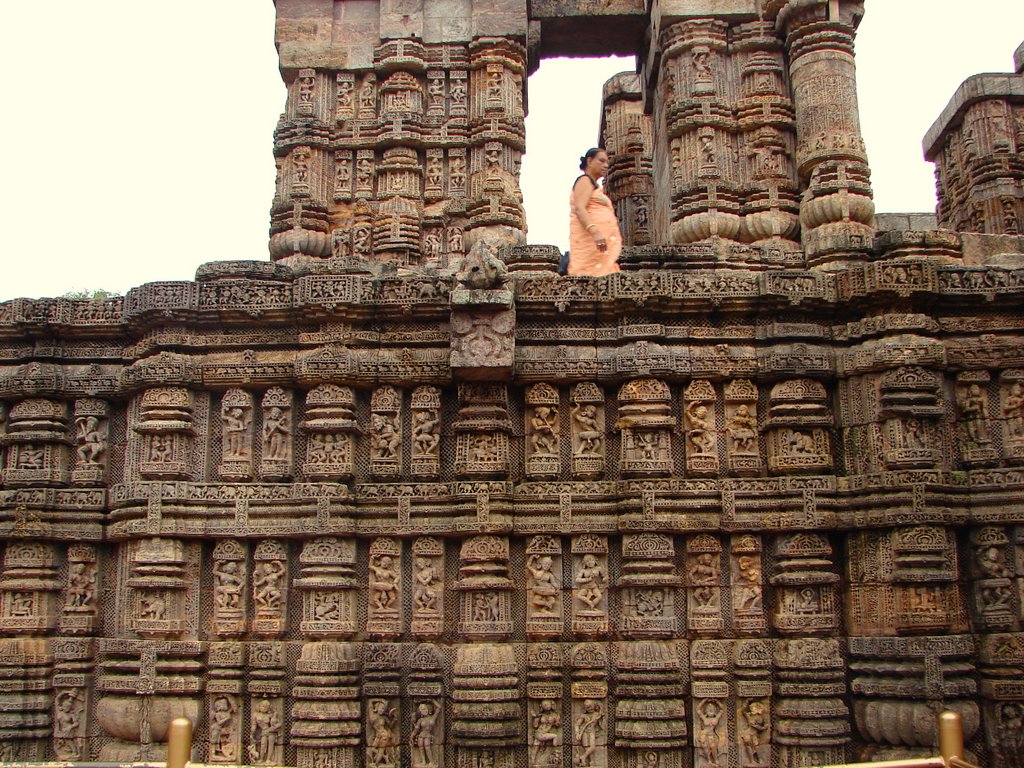
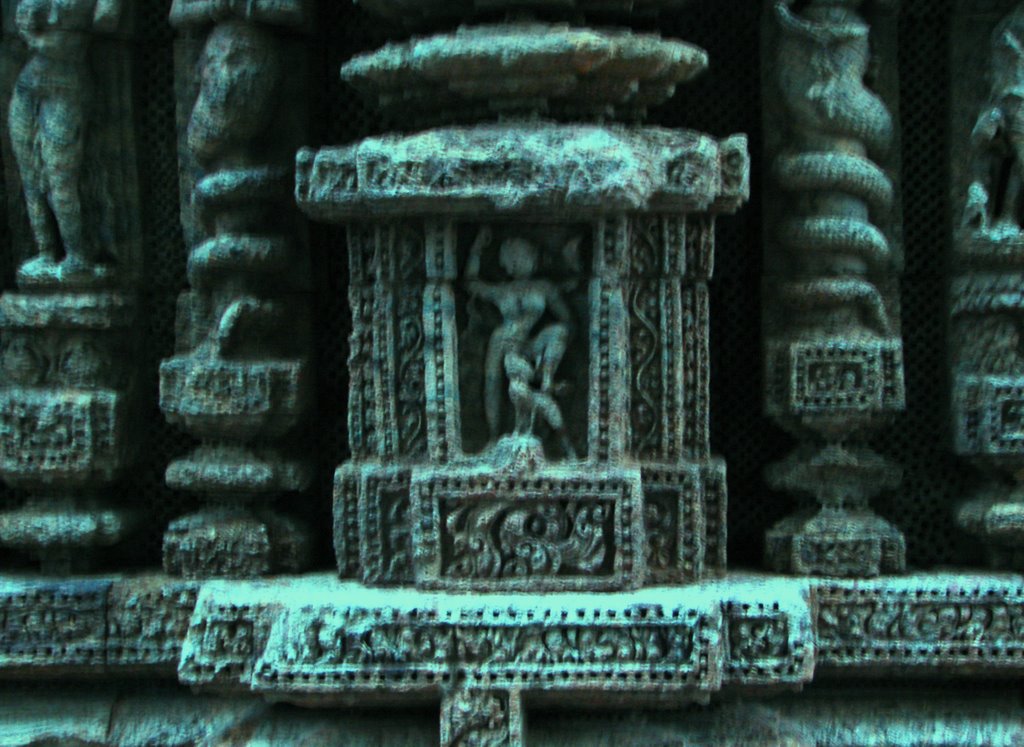
The temple has exquisite carvings of delicately poised nayikas. The slender waisted figures, languorosly poised, reflect the wealth of feminine charm. There are also nymphs or the embracing couples. There are the carvings of women playing with children or playing with pets or attending to their daily chores.


A few men were exercising in the park. A few women who had finished their early morning exercises sat besides the temple and began talking. Though the women were conversing in Oriya and I couldn't understand the exact details, I think what they were trying to decide was to which part of the country we belonged. 'U' told me that they thought 'U' was from Bengal. But I'm sure I heard the word 'Madras' in their conversation. Well, to most of the people in our country who live in the North, South India is just Madras and all the South Indians eat only Idli and Dosa! The knowledge of the North Indians is so limited that they cannot differentiate between the states in the South. It is sad but true. We both have all the defining features of the Dravidians and I am sure the women would have noticed that!

By then I saw an officer at the ticket counter and we went back to buy our entry tickets. We returned to the temple and took some more pictures.


It was 7:30AM and we had to take the guided tour of Bhubaneswar city at 9:00AM. We had just enough time to return to the hotel, have our breakfast and check out of the hotel. We finished our breakfast at the Panth Nivas restaurant and checked out. We kept our baggage at the reception and boarded the bus. We were on our way to "Nandan Kanan"...

02 October, 2006

Atri

We were ready by 6:15A.M. on the 17th of Sept 2006 to leave Konark. We had to leave latest by 6:30 A.M., if we had to board the 8:30AM train to Bhubaneswar. Having experienced the bad transportation facilities in the state that was as good as non-existant, we didn't want to miss the train. We didn't know when the next train to Bhubaneswar would be or if there was any at all later in the day.

It was cloudy though it had stopped raining. We were disappointed as we couldn't go to the temple complex to watch the sun rise. Since we didn't have anything much to look forward to, we decided to leave immediately rather than wait till 6:30A.M. But we couldn't find the driver. The panth nivas (Govt. guest house) where we had stayed the previous night, was opposite the temple complex. We strolled into the complex hoping to take a few pictures of the temple in the morning. We hadn't been able to get any good pictures the previous evening owing to the heavy rainfall. We weren't very fortunate this morning either.

It was too gloomy and it meant we couldn't get any good pictures. So we didn't buy a ticket to enter the temple complex, instead saw the temple from outside and retuned to Panthnivas. The driver was waiting for us at the reception.


We reached Puri railway station at 8:15A.M. The driver took to us to the ticket counter where at least thirty people had lined up to buy tickets. We would definitely miss the train :(. But the driver walked right up to the ticket counter and asked the man at the counter to give us two tickets to Bhubaneswar. I don't appreciate breaking the discipline and so told the driver that we should probably stand in the queue and wait for our turn. But he insisted that we would miss our train and the man at the counter didn't seem to mind either. He issued two tickets to Bhubaneswar and asked me to pay him exact fare. I handed him a fifty rupees note that he angrily returned and rudly told me to pay the exact change. I don't seem to recall what the fare was but I do remember digging into my purse and pooling all the change I had and paying for the tickets. A few people in the queue expressed their anger by swearing at us in Oriya that I didn't understand.

We ran towards the platform to board the train to Bhubaneswar. We got into a car besides the "vendors car". I had never seen a "vendors car" before. Now I wish I had taken a picture for my memoir.

The train wasn't crowded and we found a seat as well. We reached Bhubaneswar comfortably and walked to the OTDC information centre at the railway station. We booked a tour for the 18th of Aug that included sightseeing of Bhubaneswar city, Dhauli, Khandagiri, Udayagiri and Nandankanan. The tour bus would pick us up from Pantha Nivas the next morning at 9:00A.M. Since the autos in Orissa do not have meters we had to bargain the fare everytime we went someplace. We enquired about the fare that we had to pay the auto driver. The man at the information centre suggested we walk over to the auto stand that was on other side of the station. He advised us to pay 20Rs. We walked over the foot bridge again and took an auto to Pantha nivas.

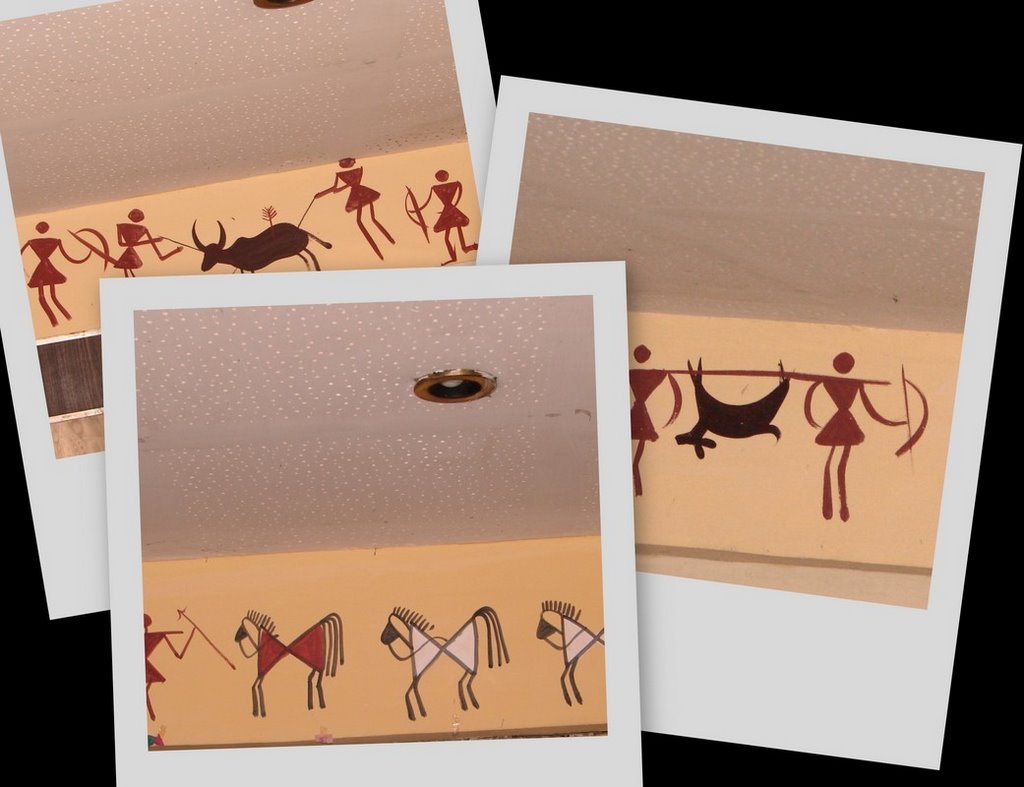
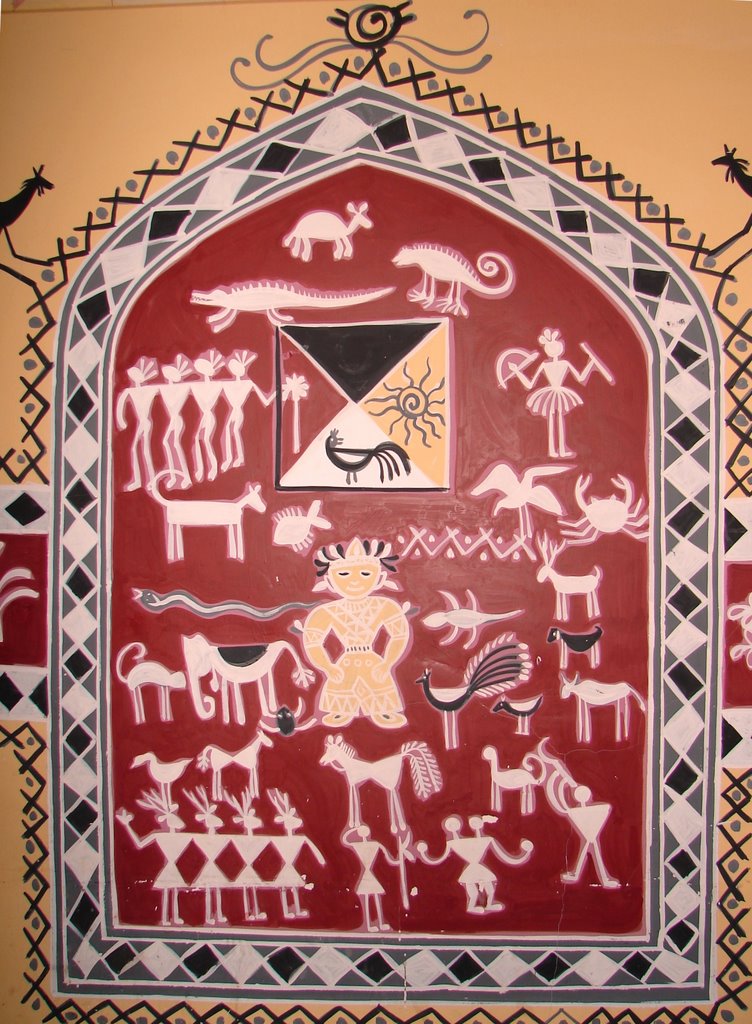
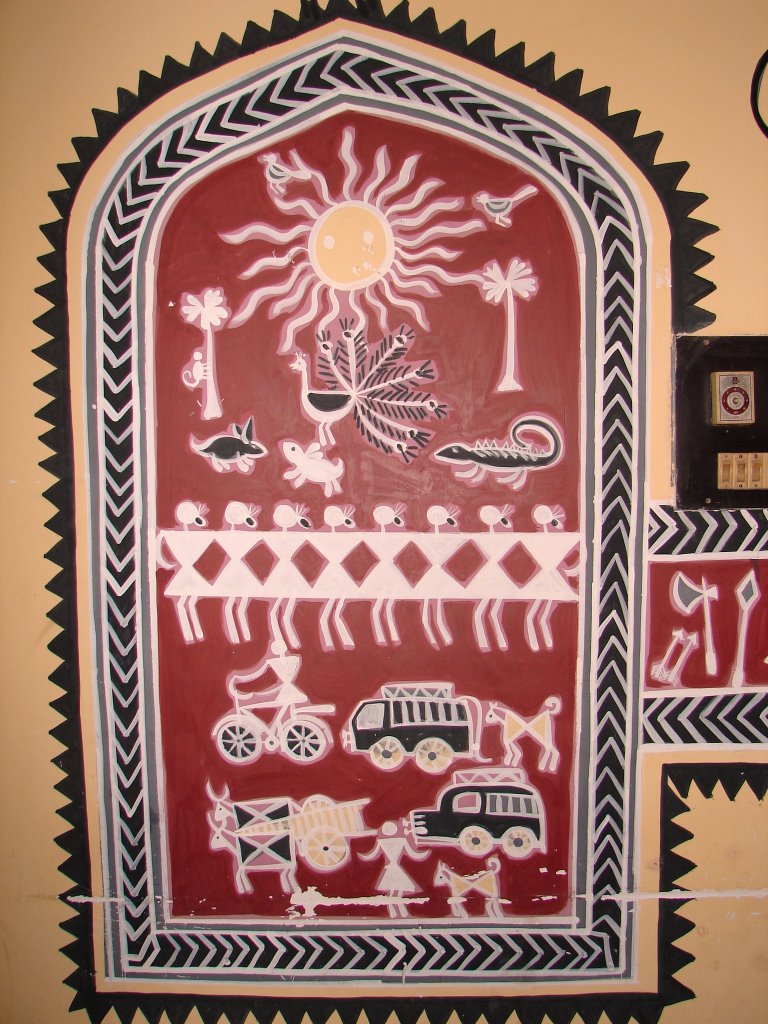
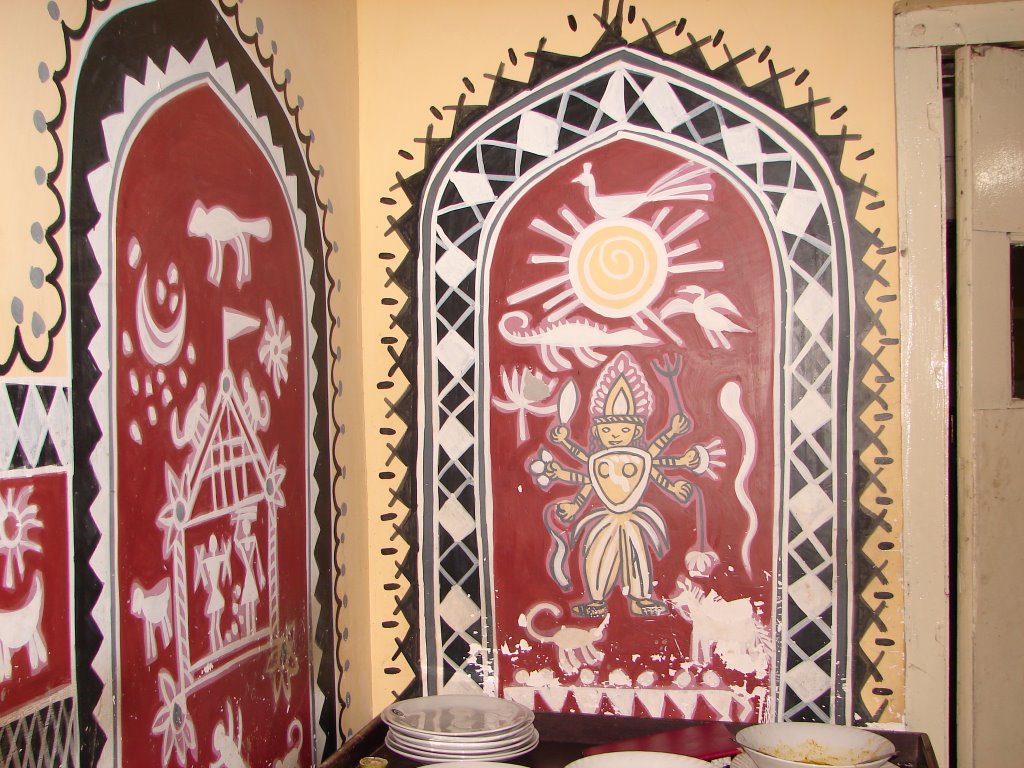
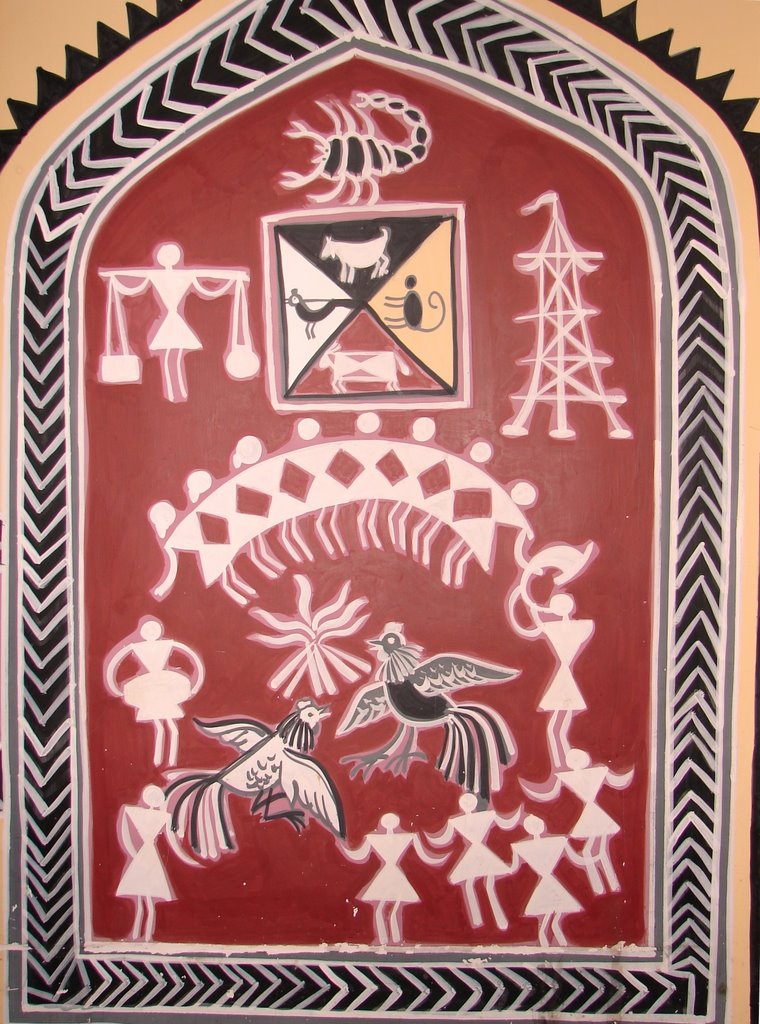
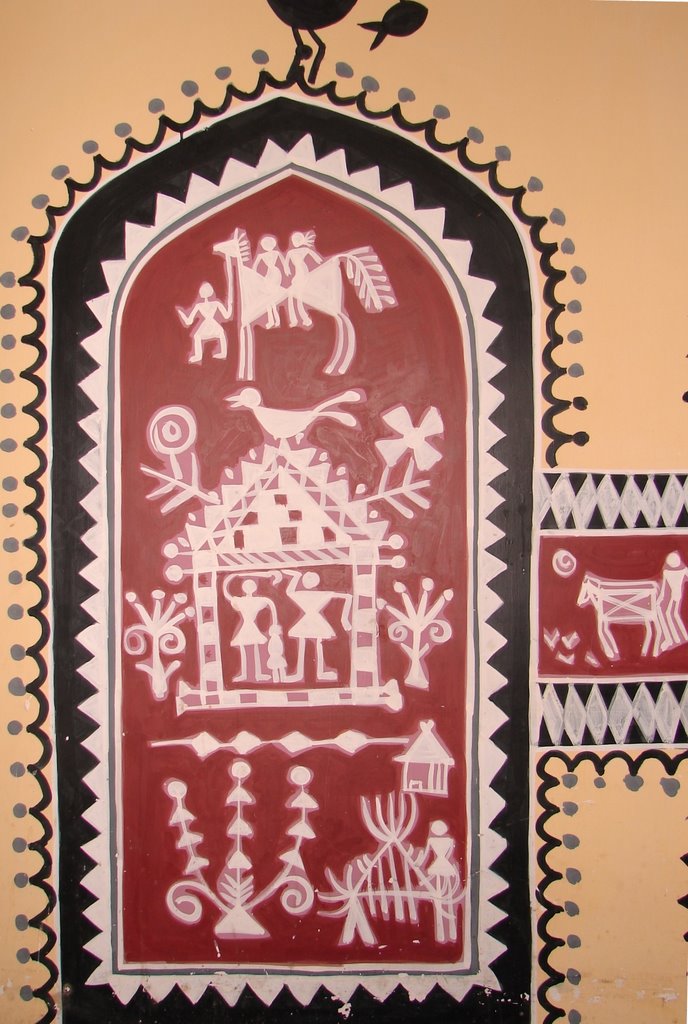
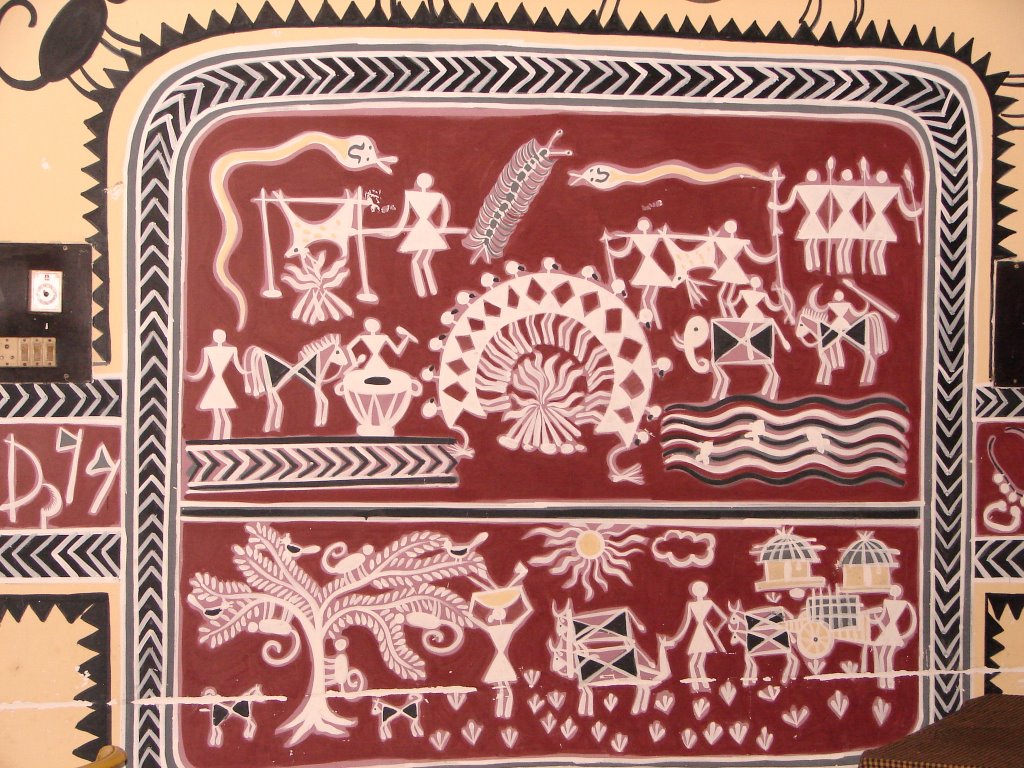
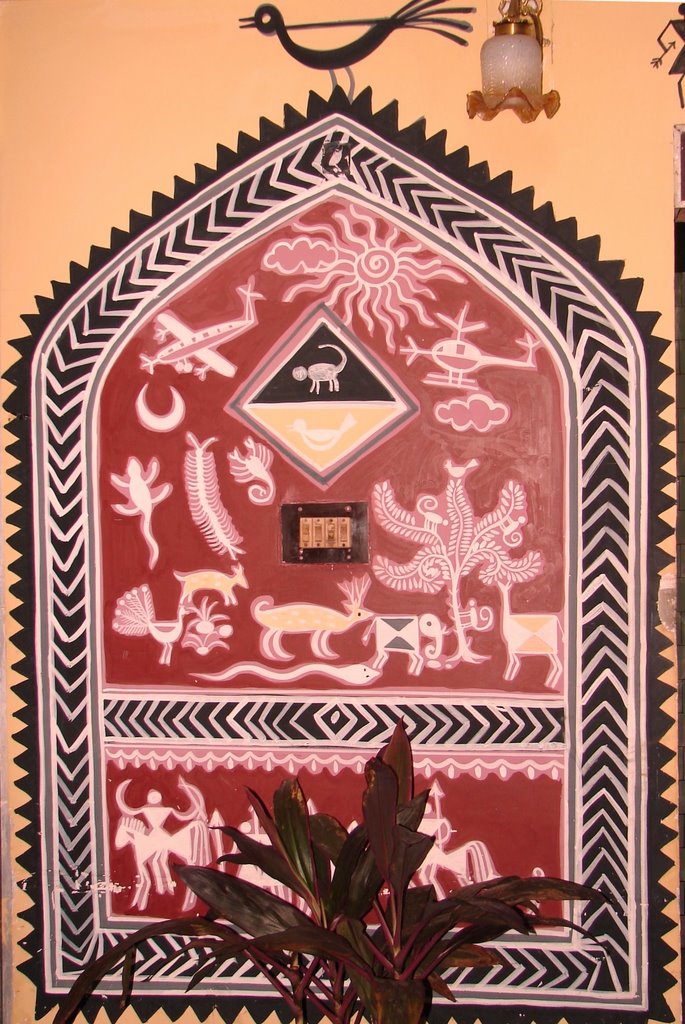
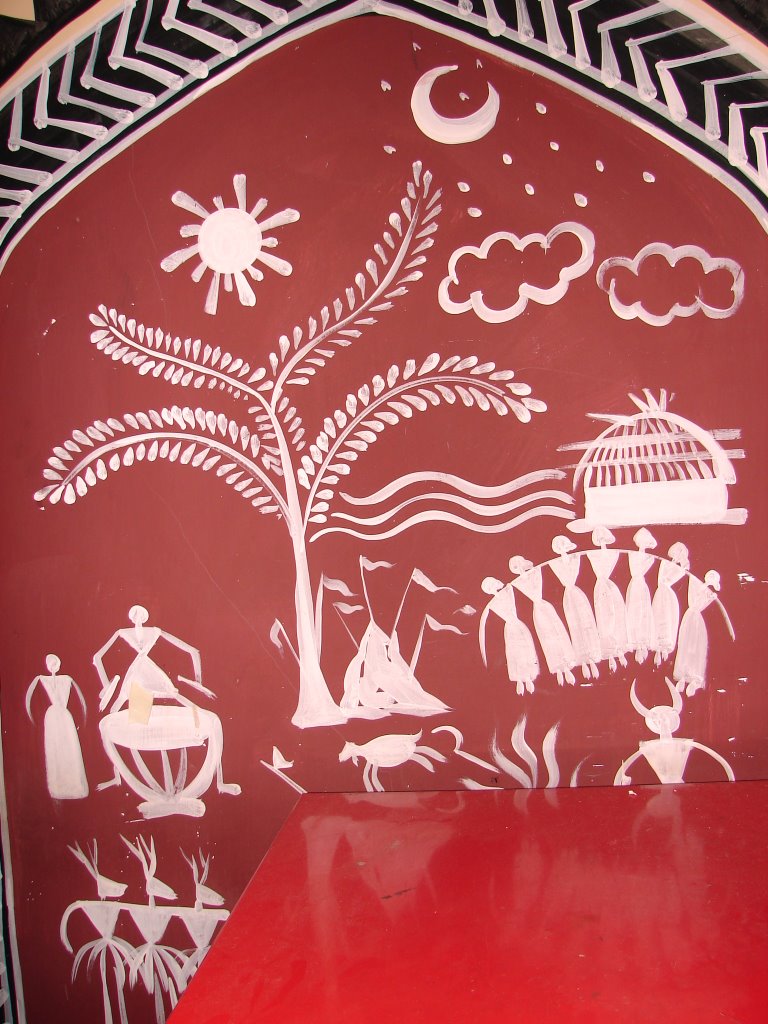
We checked in at the Panth Nivas. The room wasn't very clean. The beds though were made, didn't look clean enough. It didn't look worth the 400Rs that we had paid for a day. We freshened up and had brunch at the Panth Nivas restaurant. The restaurant walls were decorated beautifully with tribal paintings.


Fortunately the week long strike of the private bus owners had ended and the buses were plying regularly now. As per the Panth Nivas manager's suggestion we took a shared auto to the new bus stand. We shared the auto with a newly married couple who were returning to their village after visiting the lady's uncle in Bhubaneswar. The man was well travelled and he could speak Hindi. The woman was keen to strike a conversation with us but we can't speak Oriya.

There were a large number of buses at the bus station. But none were going towards Atri. The one bus that would go anyplace near Atri was already filled up. The conductor told us to go to the main road and wait for buses from other cities.We waited for a while but all the buses that came there were filled up. A few auto drivers approached us and tried to bargain with us to take us to Atri. We didn't show any interest in their offer. After waiting for a while we were contemplating about taking an auto to Atri when private bus stopped right besides us. The conductor told us that the bus would go to Atri. We told him that we wouldn't be interested in taking the bus unless we could sit comfortably. He asked a few passengers to move and gave us two seats. We were finally on the way to Atri.

After riding on the bus for almost an hour we reached Khorda town. The driver told us that we had to get off as he wouldn't be going any further. I was angry that the conductor had lied to us. We got off at the bus station to wait for the next bus to Atri. All the buses that came to the town bus station were overcrowded. By now it was almost 1:30P.M. and we had to also ensure that we left Atri by 4:00P.M. as there were no buses after that. Left with no choice we boarded the next bus to Atri. I stood on the footboard. Once the bus was out of the station I managed to move further in. I travelled the next 10 Kms standing on one foot. The man standing besides me would literally fall on me everytime the driver braked. I pushed him with my bag a couple of times but he didn't budge. I also warned him few times to stand straight. Seeing me uncomfortable another man who was sitting offered me his seat. By then we had reached Atri and I thanked the man for offering his seat and got off the bus.

Situated amidst greenery and famous for the hot sulphur water spring, Atri, 42 km. from Bhubaneswar and 14 km. from Khurda, is also a holy place with the shrine of Hatakeswar. A bath in the spring water is reputed to cure skin diseases apart from being a pleasant experience.

OTDC also has a pantha nivas in Atri. We didn't see anybody near the guest house though. We weren't surprised!The hot water spring in Atri (or "Otri" as the natives pronounce it) is nothing more than a small well that is a few feet deep. As soon as we got off the auto, a couple of Brahmin priests ran towards us with small brass pictures in their hands. One of them started talking to my friend U. I didn't show any interest in what he had to say as I knew his only intention was to make some money. He drew some water from the well and poured it on U's outstreached palm. Now that 'U' had already taken some water from his picture we had to pay him some money. I didn't resist when he offered me some water next as we had to pay him anywayz...
In all we spent about 15 minutes in Atri. We returned to the main road to wait for the next bus to either Khorda or Bhubaneswar. Fortunately we got a direct bus to Bhubaneswar.

30 September, 2006

Sun Temple -- Konark


The worship of Sun in India is several centuries old.The Sun God is referred to as Surya or Aditya. The Vedas are full of hymns describing the Sun as the source and sustainer of all life on earth. Several temples in India enshrine Sun as the principal deity.The grandest temple dedicated to Sun God is at Konark.

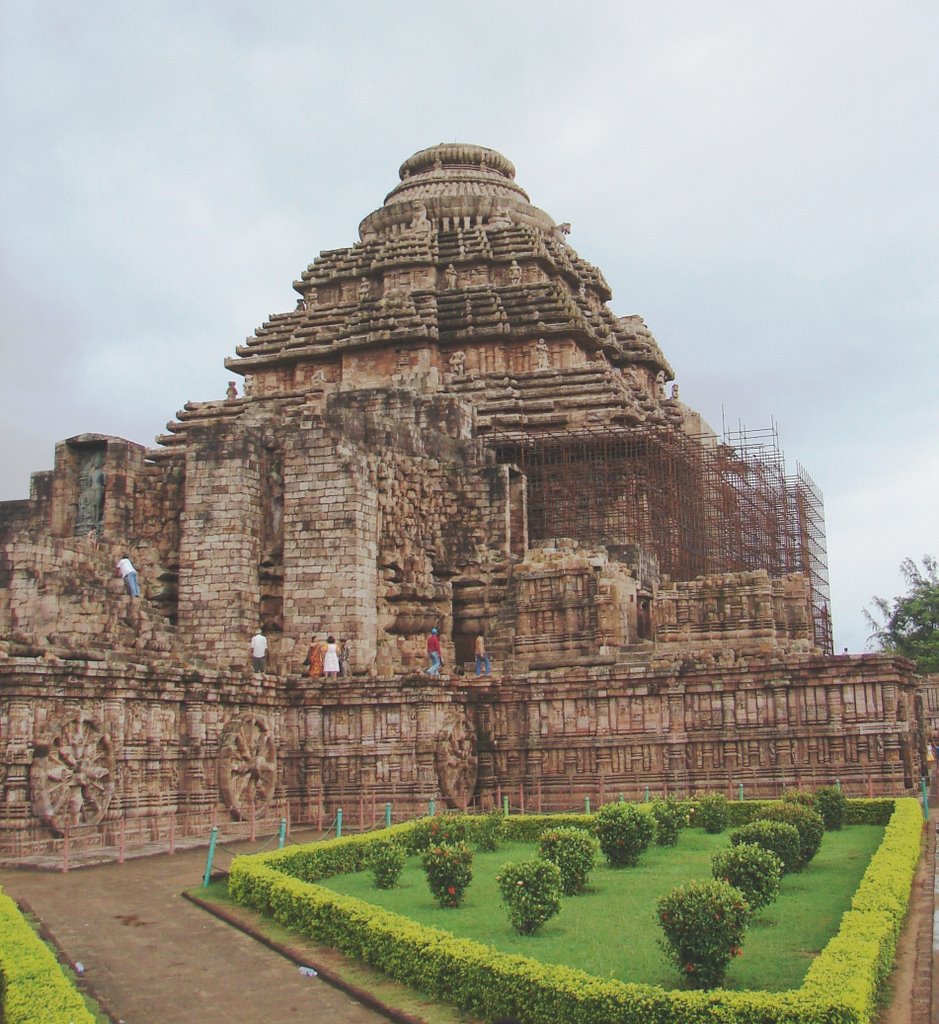
The Sun temple at Konark was built by Ganga ruler Narasingha Deva to commomorate his victory over the muslim rulers. During his reign he recorded at least three victories over the muslim invaders. The black granite of this structure earned the name 'Black Pagoda' from the 17th C European sailors who must have seen it from the sea.

The fame for this temple had spread far beyod the limits of Orissa in the 16th C. Abul Fazal, the famous chronicler of the court of Akbar wrote "Even those whose judgement is critical and who are difficult to please stand astonished at its sight".

The Ganga dynasty had a militia of 300,000 men with 50,000 foot and 10,000 horses and an elephant regiment of 25,000 strong. The priest at the Jagannatha temple were renouned for their physical prowess and excercised in the religious gymnasia. The higher posts in the army were held by the priestly Brahmin caste. Narasingha himself was renouned for his valour. This combined with the impressive military history, supports the theory that the temple was a colossal tower of victory, erected to the Sun God thanking him for his earthly representative's (King Narasingha Deva) victory over the dreaded Muslim. The profusion of carvings on and around the temple depicting military subjects, seems to confirm it.

King Narasingha was also known as "Langulia" -- "one with a tail". It is also possible that he built the temple as a supplication to Surya to remove a spinal swelling of some sort.

No one really knows why a temple was built here, but there are many legends that account for its appearance. The most popular legend is that 'Sambha' the son of Krishna built the temple here. Sambha was very handsome and he was proud of it. One day he made the mistake of ridiculing Narada, a celebrated sage who was not renowned for his looks. He decided to take revenge on Sambha.

He lured Sambha into a pool where his step mothers were bathing. Krishna was furious and cursed him with leprosy. When he realised it was Narada who had lured him there, Krishna advised his son to worship the Sun God and hope for a cure. After a penance for twelve years, he was finally cured. Sambha built a Sun temple at that spot. It was called "Konark" --"Kona" meaning "corner" and "Arka" meaning "Sun"; hence "corner of the sun".

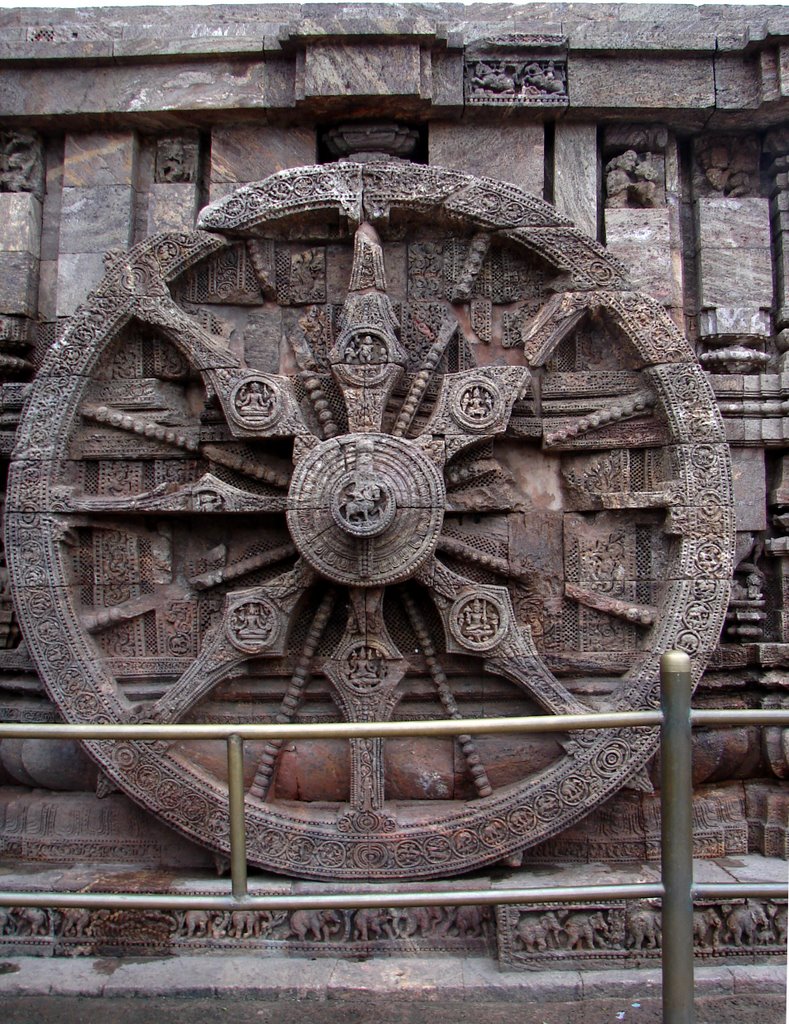
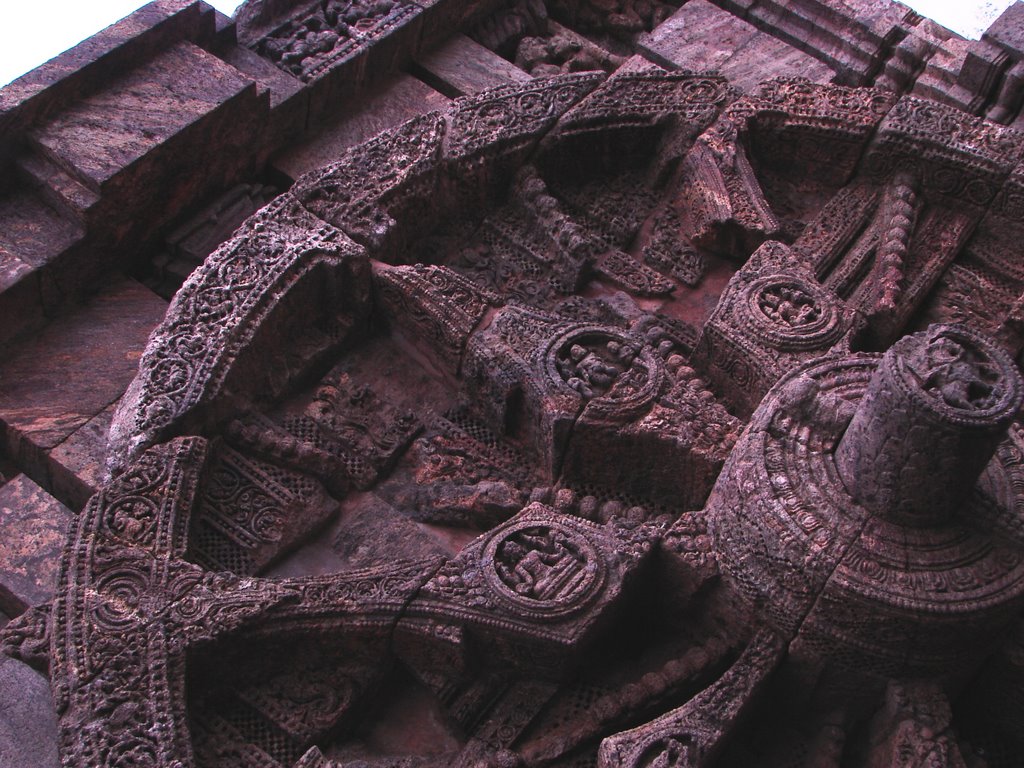
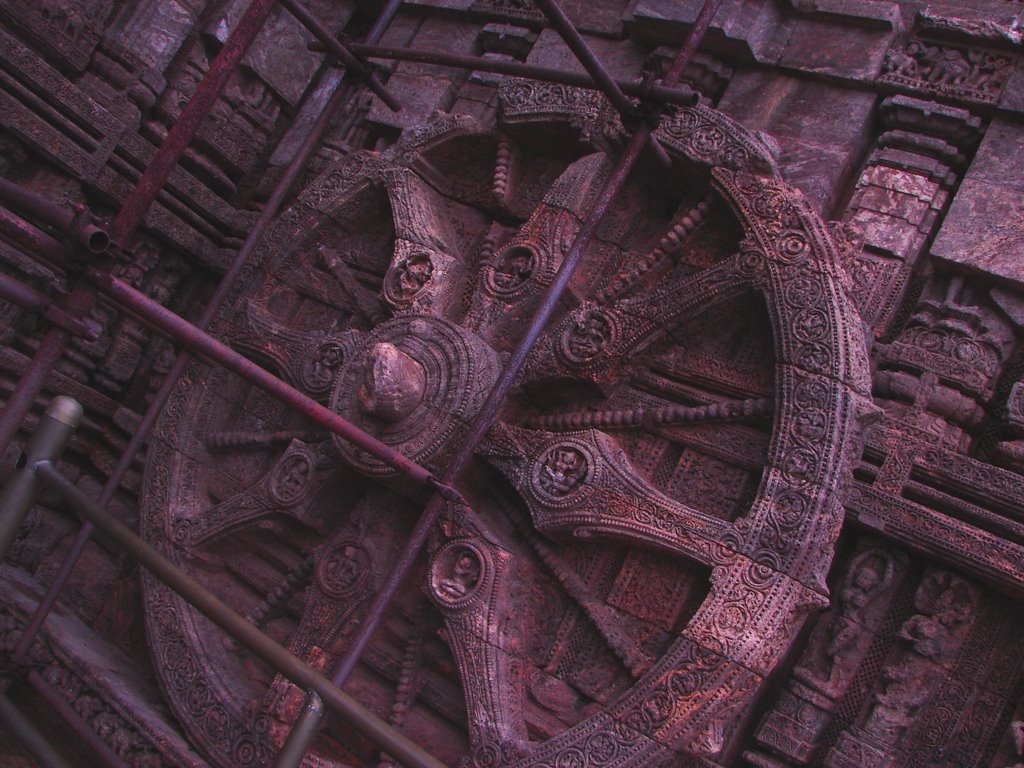
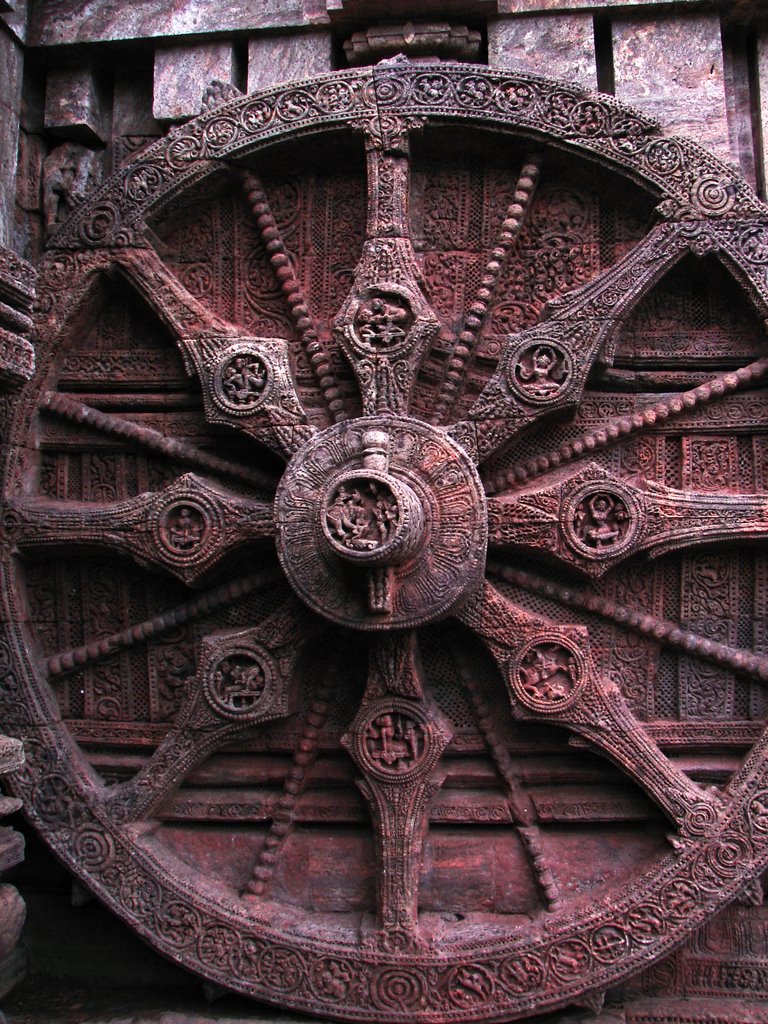
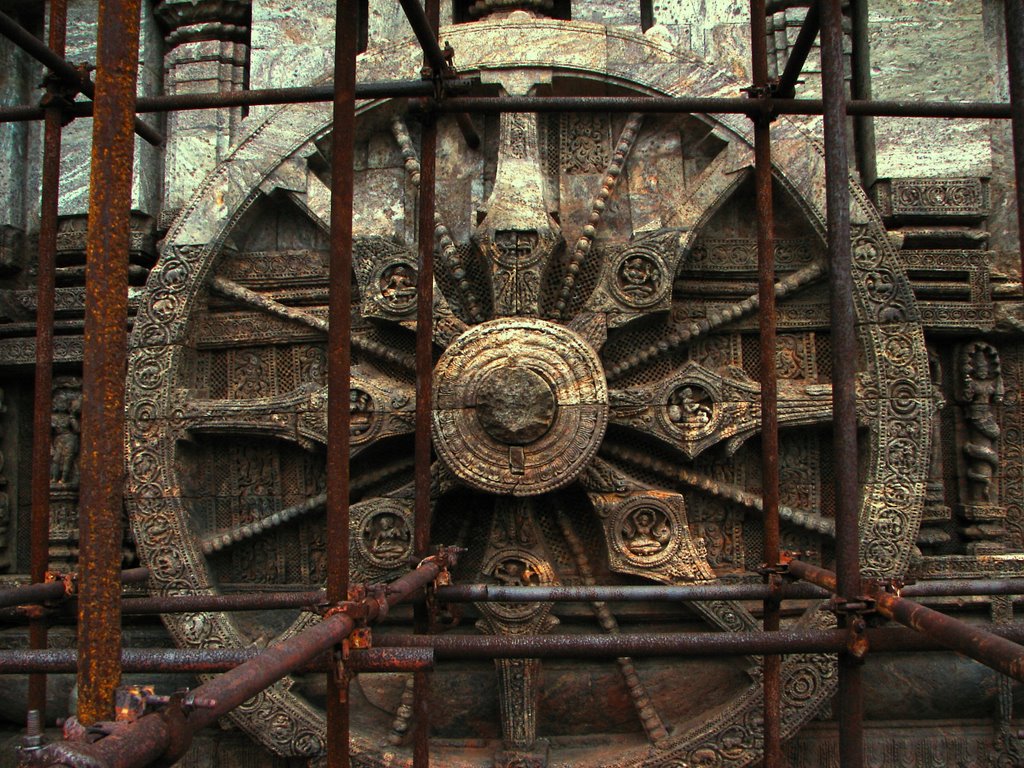
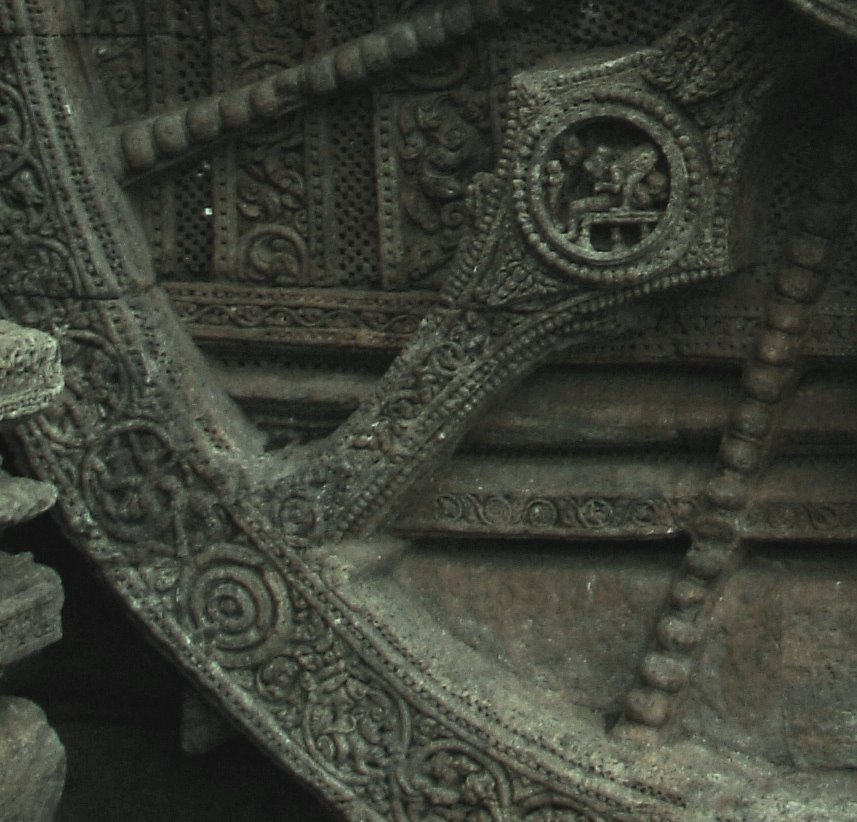
The entire temple has been designed in the form of gigantic chariot of the Sun God, taking him across the heaven. On days close to the equinox the Sun would shine at dawn or sunset on the Sun God in the temple, before the idol was removed. The temple has 24 wheels; each with 8 spokes and exquisite carvings. 7 horses drag the chariot. The 7 horses represent the 7 days of the week and the 24 huge wheels represent the hours of the day.Some believe that the wheels represent each month in the Hindu Calendar with the spokes being one of the part of the Hindu day (the wheels represent the 24 fortnights of the Indian year)


The decorated wheels act as the sun dials. Each wheel consists of 8 spokes that indicate 8 'praharas' of the day, one prahara being equal to 3 hours of time. The hub of the wheel casts shadow on the spokes indicating time.


Konark is not an isolated monument but a whole complex of temples. There is the main temple which is a combination of several structural elements like the chariot with the 24 wheels, a platform with a porch, the 'bhoga mantapa', 'nata mantapa' and the Mayadevi temple. Though the main sanctum is in ruins, the 'nata madapa' is in tact.

Sensuous Odissi dance poses are found in the sculptures. Traditionally the classical dance form of Odissi was performed as Mahari or Devadasi dance in temples dedicated to lord Jagannatha and also at the Konark sun temple.

With social and political changes in the country and also the supression of the dance form by the British authority the classical dance form moved out of the temples. Young dancers called 'Gotipuas' performed dances outside the temple premises.

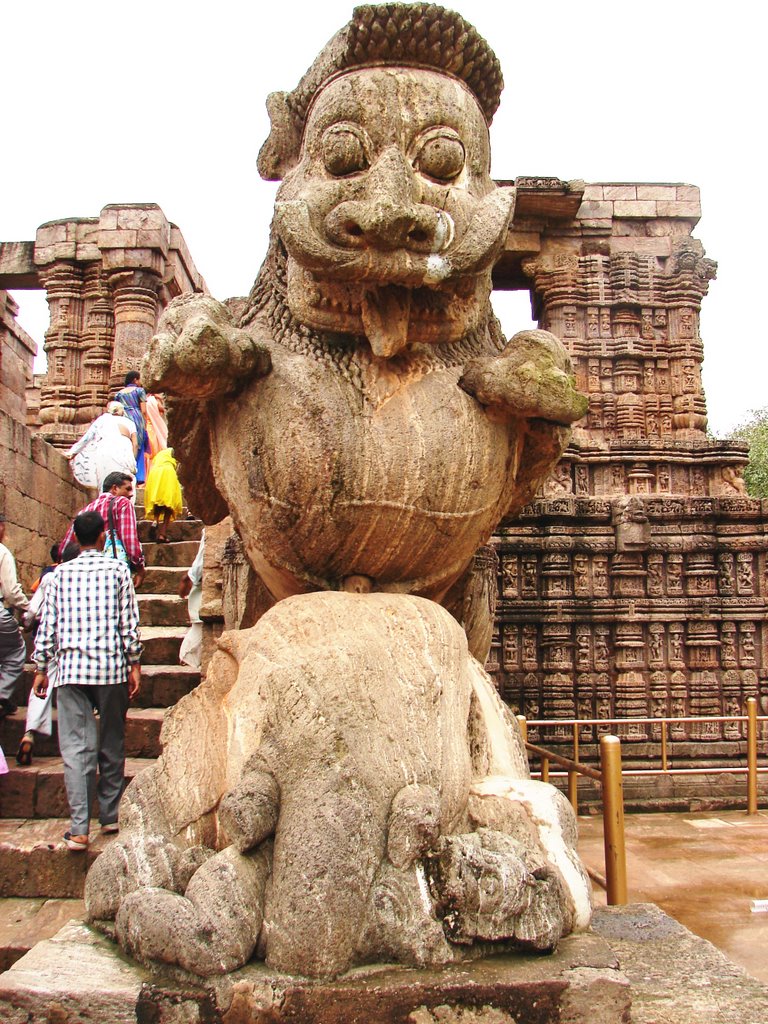
This beautiful sculpture at the entrance to the temple is known as "nara gaja simha" (man elephant lion). The sculpture comprises of a man being crushed by an elephant that in turn is being crushed by the lion.
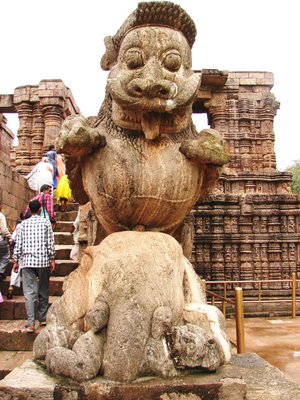


The guide explained to us that
"The man in the sculpture represents us. Born as free men we roam the world and acquire all the wealth. The elephant symbolises the wealth. Obsessed with wealth we commit sins. This wealth (elephant) crushes us. With wealth man acquires power. The lion symbolises the power. This greed for power will consume our wealth and finally crush and destroy us."

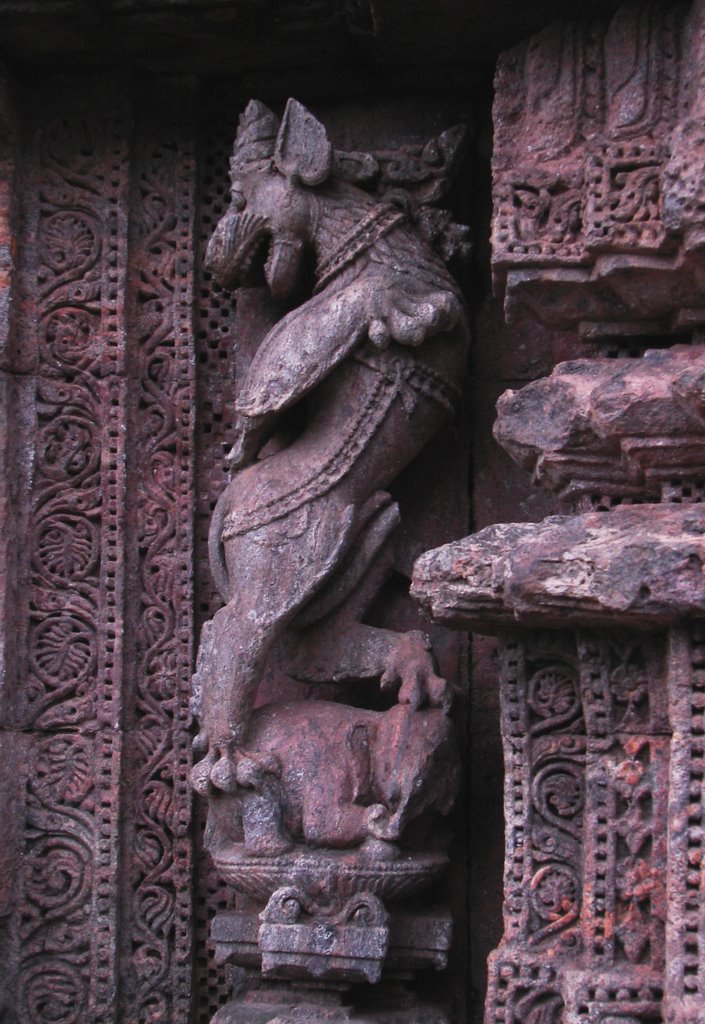
Lions gates are an important feature of Orissan architecture. Lions are installed at the entrance of temples. The lions have big sharp noses and thick moustaches.


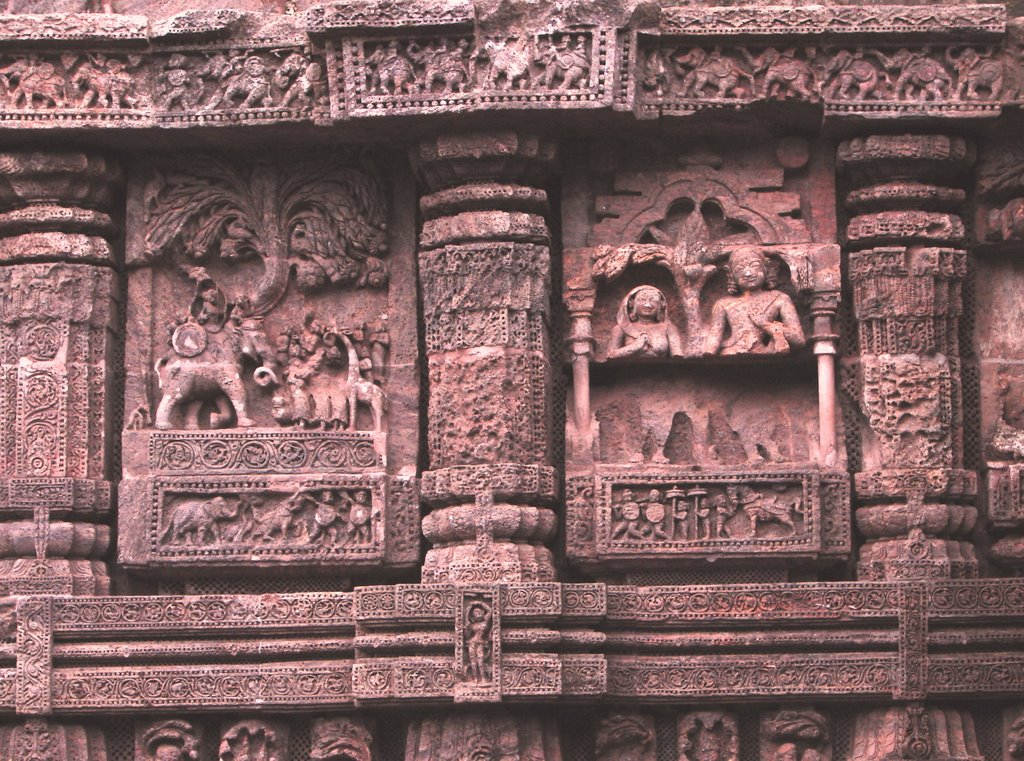
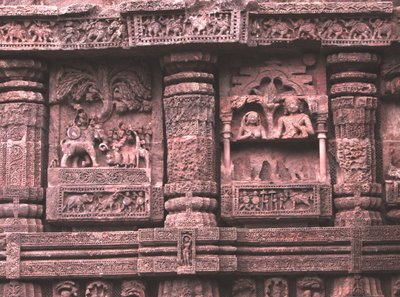
Besides the sculptures of the 'Devadasis' there are also sculptures depicting scenes from every day life. The picture on the left (above) depicts a lady waiting for her husband to return home from work.


The picture on the left depicts a quarrel between a mother-in-law (the woman on the left with her hand on the hip) and her daughter-in-law.


The guide interpreted the picture on the left as a woman seeking the help of a dog to clean up after birthing a child. I am not sure if that is what the sculptor intended it to be.
Three different kinds of stones were used in the construction of the temple. Chlorite was used in the door-frame;laterite in the foundation, staircase and the centre of the platform. Khondalite was used elsewhere. It is of poor quality. None of these are available locally. The stones were smoothly finished and then fitted together. Designs were cared on them only after that.

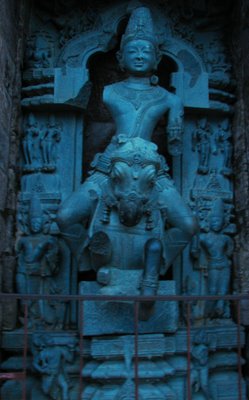


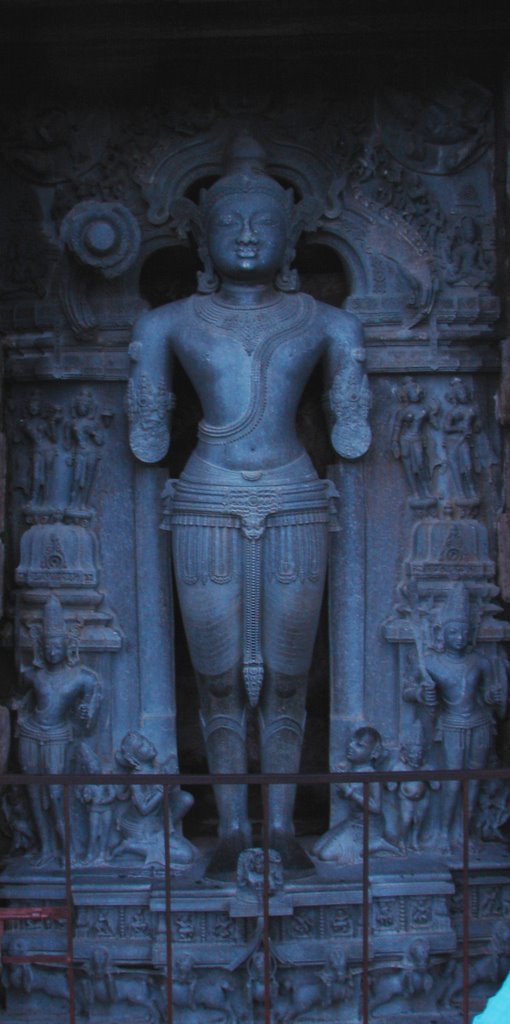
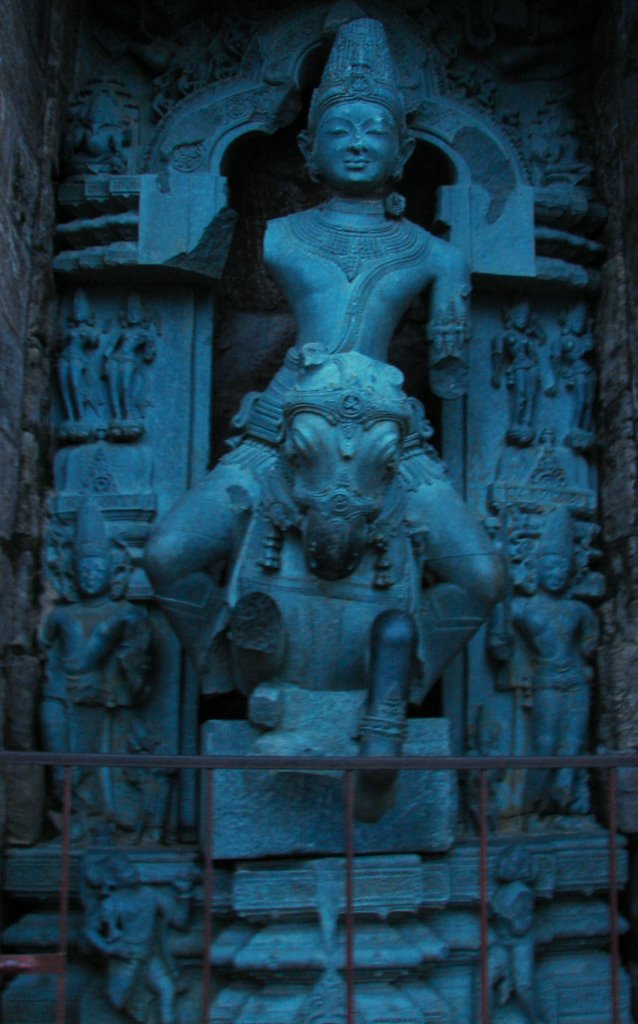
The main idol of the Sun God on which the sunrays used to fall in the morning was removed by some Portuguese navigators. There are three images of the Sun God positioned to catch the rays of the sun at dawn, noon and Sunset.

The sun rays at dawn fall on the first image (top left), on the image at the centre at noon and the rays fall on the image at dusk on the image on the right.

The guide told us that we had to sit for a while in front of the image that catches the sun rays at dawn. This is to please the Sun God that represents the infant Sun. Children often demand attention from everyone; and this image is no different. If you do not pay him all the attention that he seeks, he will be angry! The image that catches the sun rays at noon represents the "youth". The God sits on his horse in the evening as he will be tired after a whole day's job. The sculptors had some imagination!
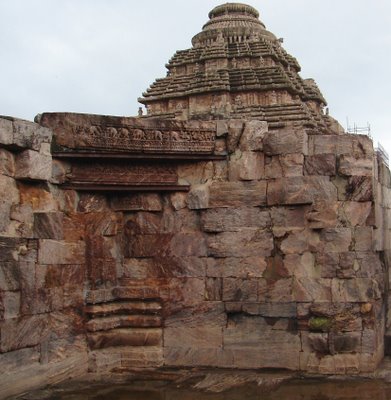


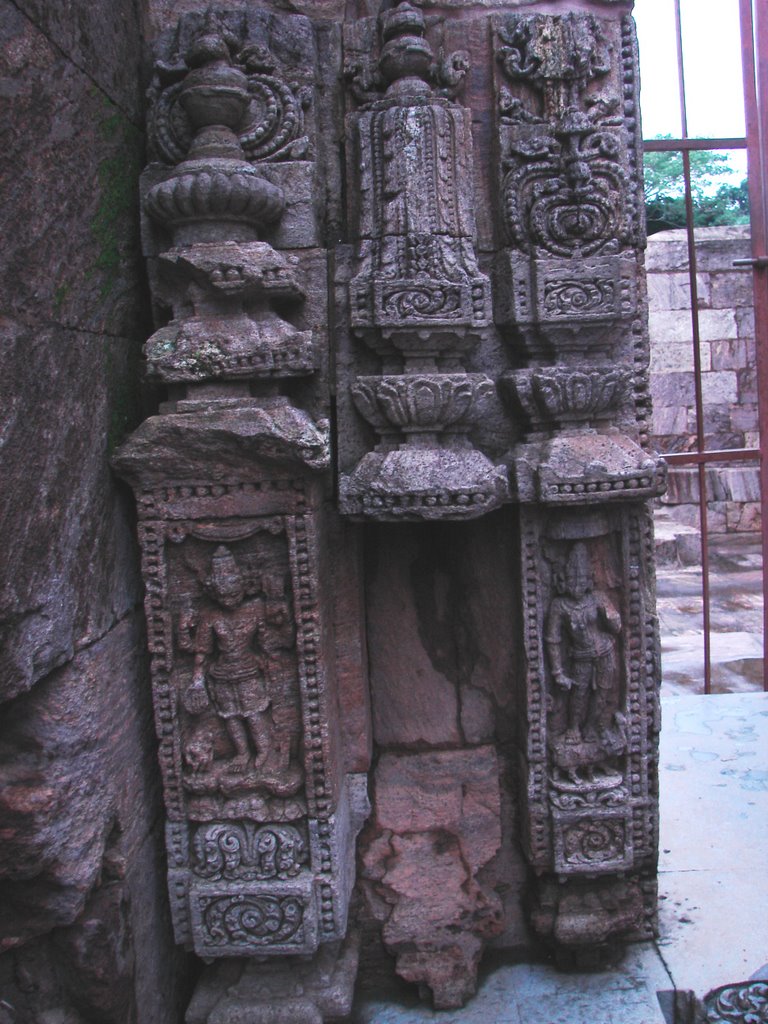
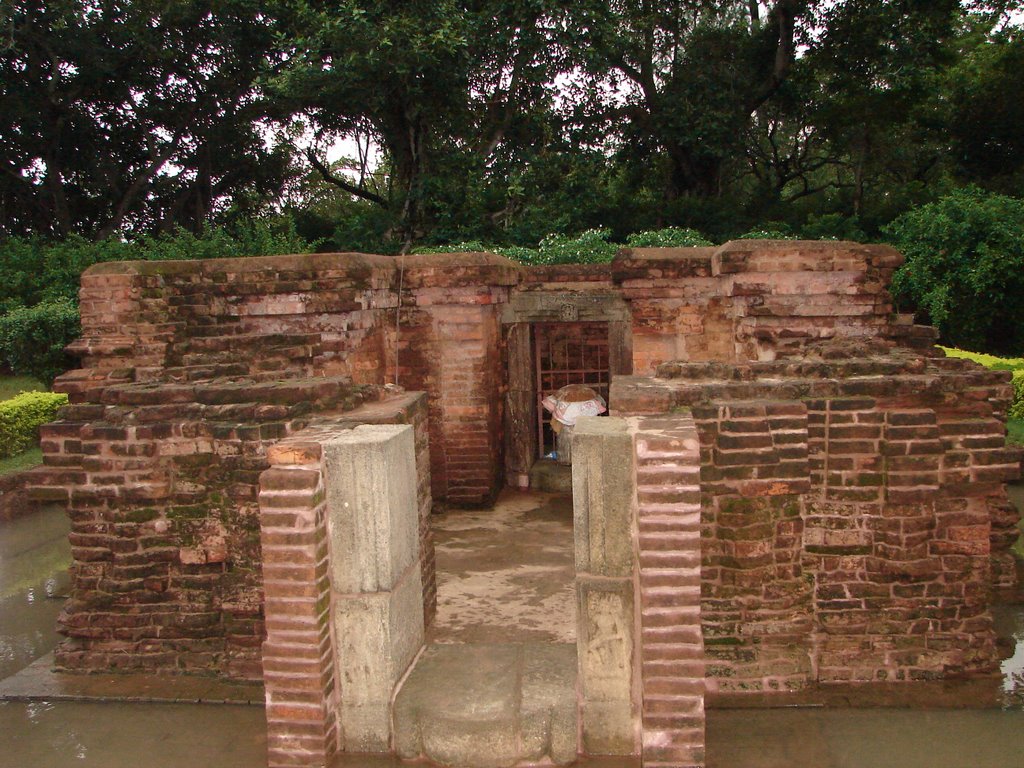
Of the 22 subsidiary temples that stood in the temple complex, only two remain to the west of the tower: The Vaishnava temple and the Mayadevi temple. The temple of Chhaya devi and her idol are in a desecrated state. The picture above shows one wall of the Chhaya devi temple.

The Hindu mythology syas that for several yugas Aditya was without a wife or a sister and he revolved around the earth once everyday. This made him hot and wild tempered. Brahma realised the reason for the agitation and created Gayathri as his sister. This pacified Aditya. He married Samgnya and their combined influence calmed Aditya.

Samgnya's marriage to Aditya was a love marriage but his heat terrified her. Then Gayatri suggested to leave behind her shadow (Chhaya) to function as Aditya's wife and go back to her parents' house.

When the Sun God discovers the deception, he goes to his father-in-law's house to find out what happened to his wife Samjna. His father-in-law Tvastr explains that his daughter found the Sun too bright to bear. Then the Sun God allows Tvastr to put him on his cutting lathe and shear away the excess brilliance until the Sun becomes beautiful again. Surya then reunites with his wife Samjna.


The picture on the left (above) is from the temple of Chhaya devi. The image on the right is Chhaya devi.


The guide then showed us another structure that he said was the shrine of Goddess Maya devi. He also told us that she was the second wife of Sun God. I haven't really found any evidence on the internet that supports his theory of the Sun God having two wives:). But the guide told us some wonderful stories and he also showed us the entire temple complex.

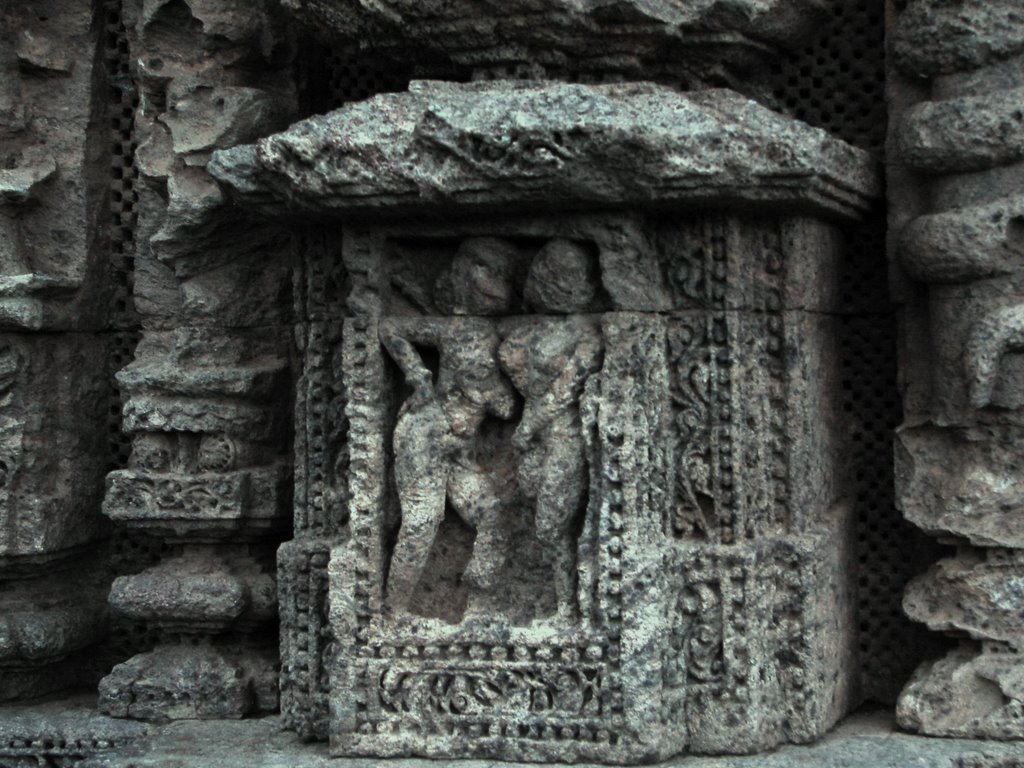
The temple of Konark is also known for figures of amorous couple. Liberal representation of such erotic figures was a fashion of not just the Hindu temples, but also Jain and Buddhist monuments.


It is believed that erotic sculptures are helpful in warding off the anger of natural calamities. It is described that the obscene sculptures were meant to rouse in the minds of the visitors a sense of what is sensual, therefore avoidable and a sense of what is spiritual, therefore desirable.


Eroticism occupies almost all segments of Konark temple. The amorous couple, the perfect female figures in seductive poses and their bewitching smiles have made Konark a feast for the eyes of all visitors. Konark stands unrivalled in the domain of romantic art. In the words of Rabindranath Tagore -- " The language of man is here defeated by the language of stone"...